
What to Expect During Liposuction Recovery: A Comprehensive Guide
Updated April 2026
Recovery Is Where the Result Is Made or Lost
The surgery removes the fat. The recovery determines how well the result looks and how long it lasts. Most patients understand this in the abstract but underestimate what it means in practice: the weeks between leaving the operating room and seeing a final result are not passive waiting time. They are an active phase of healing that responds directly to how well you follow your post-operative protocol.
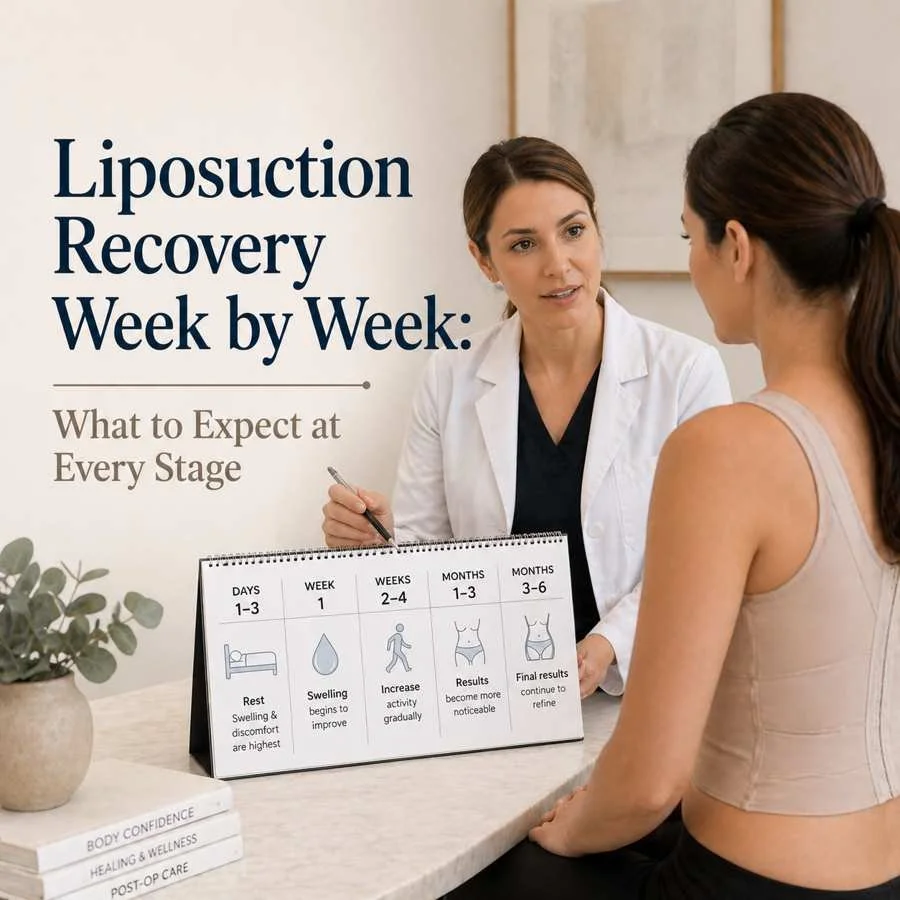
This guide covers the liposuction recovery experience week by week, from the first hours after surgery through the six-month mark where final results become fully visible. It covers what the body is doing at each stage, what you will feel, what you should be doing, what you should not be doing, and what signals are worth contacting your clinical team about. If you are preparing for liposuction or are in the middle of recovery and want a clear reference for where you are in the process, this is it.
The Day of Surgery: What Happens Before You Go Home
Liposuction is performed as an outpatient procedure in the vast majority of cases. You will not be admitted to a hospital overnight unless your procedure is unusually extensive or your health history warrants additional monitoring. Plan to have a responsible adult drive you home and stay with you for the first 24 hours. You will not be in a condition to drive, make decisions independently, or manage your own care safely in the hours immediately following surgery.
When you leave the facility, you will already be wearing a compression garment over the treated areas, and your incision sites may have small absorbent dressings in place. You will likely feel groggy from anesthesia and sedation, and the treated areas will be numb from the tumescent solution injected during the procedure. This numbness wears off over several hours, and discomfort increases as it does. Have your prescribed pain medication ready at home before surgery day so there is no gap in coverage.
Tumescent fluid drainage from the incision sites in the first 24 to 48 hours is normal and expected. This is the residual anesthetic and saline solution from the pre-operative injection, and it is pinkish or straw-colored. Absorbent pads inside your compression garment manage this. It is not bleeding and it is not a complication.
Days 1 to 3: Peak Discomfort, Peak Swelling
The first three days are the most physically uncomfortable part of recovery for most patients. Swelling peaks during this window, bruising is at its most visible, and the soreness from surgical trauma is at its most intense. Patients frequently describe the sensation as similar to having done an extremely intense workout, with deep muscle soreness throughout the treated areas combined with surface tenderness at the incision sites.
Pain management during this period is typically handled with a combination of prescription pain medication for the first few days and over-the-counter anti-inflammatories such as acetaminophen thereafter. NSAIDs like ibuprofen are generally avoided in the early post-operative period because of their effect on platelet function. Follow your clinical team's medication guidance precisely rather than improvising.
Rest is important during these first days, but complete immobility is not. Short, slow walks every few hours during waking time are actively encouraged from day one. Movement promotes circulation, reduces the risk of blood clot formation, and supports lymphatic drainage. The walks should be gentle and brief, five to ten minutes, not exercise. The goal is circulation, not exertion.
Sleep with your upper body slightly elevated if you have had abdominal or torso treatment, which reduces fluid pooling in the operated area and makes positional changes during the night less painful. Many patients find a recliner more comfortable than a flat bed during the first few days.
Days 4 to 7: Swelling Begins to Shift
By the end of the first week, peak swelling has passed and the body begins moving fluid more actively. For many patients, this means swelling shifts and redistributes rather than simply decreasing uniformly, which can cause the treated area to look uneven or lumpy at this stage. This is normal and expected. It does not reflect the final result.
Bruising transitions from deep purple and red to yellow and green as hemoglobin in the bruised tissue breaks down. This color change is a sign of normal healing progression. Bruising is typically fully resolved by weeks two to three, faster in some patients and slower in others depending on individual healing biology.
Compression garment wear should be continuous during this period, 23 hours a day, removing only to shower. Showering is typically permitted by day two or three once incision sites have sealed, but check with your clinical team for the specific clearance timing for your procedure. Pat the incision sites dry carefully after showering and replace the garment promptly.
Your first post-operative follow-up appointment at Adonis Plastic Surgery typically falls in this window. Attending it is not optional. The clinical team assesses your healing, checks incision sites, addresses any early concerns, and gives you clearance guidance for the next phase of activity. Patients who skip early follow-up appointments lose important clinical oversight during the most dynamic phase of healing.
Weeks 2 to 4: The Functional Recovery Phase
By the end of week two, most patients feel meaningfully better and are tempted to return to normal life faster than is advisable. This is the phase where post-operative compliance most commonly breaks down, and where the consequences of non-compliance are most directly felt in the final result.
Swelling continues to reduce but is far from resolved. The treated areas will feel firm and somewhat rigid beneath the skin as collagen is being deposited and the tissue remodels. This firmness is normal and does not indicate a problem. It softens progressively over the following months.
Most patients can return to desk-based work within five to seven days. Driving can resume once you are off prescription pain medication and can react normally, typically within a week for smaller procedures. Physical labor, commutes involving extended sitting or standing, and any job requiring physical exertion require a longer clearance timeline that should be discussed with your clinical team based on your specific procedure.
Light walking can increase in duration and pace during weeks two to four. Light cardio such as stationary cycling at low resistance is typically permissible by week three for patients who have had smaller procedures, and by week four to five for larger volume treatments. Core exercise, heavy lifting, and high-impact activity remain off limits until the six-week clearance appointment.
If lymphatic drainage massage has not already begun, this is the window to start. Sessions with a therapist trained in post-surgical lymphatic technique, ideally weekly for four to six weeks, significantly accelerate fluid clearance, reduce the duration of firmness in treated areas, and improve the smoothness of the early result. Research supported by the National Institutes of Health documents the role of manual lymphatic drainage in reducing post-surgical edema and improving recovery outcomes.
Weeks 4 to 6: Visible Progress, Continued Caution
By week four to six, most patients are feeling largely normal in daily life and beginning to see meaningful changes in their shape. Swelling has reduced substantially, though it has not fully resolved. The compression garment is typically transitioned to daytime-only wear during this phase for most patients, though nighttime wear for an additional two to four weeks is sometimes recommended for larger procedures.
The six-week post-operative appointment is a significant milestone. The clinical team assesses overall healing, evaluates the developing contour, and clears patients for return to full physical activity including exercise, lifting, and high-impact movement. This clearance should be received at the appointment rather than assumed based on how you feel. Some patients heal faster and some slower, and the assessment is individualized.
Scar management typically begins around this time for patients who are using silicone gel or silicone sheets on their incision sites. Incisions should be fully closed before topical scar treatments are applied. Sun protection over healing incision sites is important year-round in Southern California and should be maintained throughout the scar maturation period.
Months 2 to 6: The Result Develops
This is the phase patients most consistently underestimate. By six weeks, most patients feel recovered, look meaningfully better, and are back to normal life. But the result continues to improve significantly through the six-month mark as residual deep tissue swelling resolves, collagen remodels, and the skin completes its retraction to the new underlying contour.
Patients who judge their final result at six weeks are seeing an interim outcome. The waist definition, muscle visibility in HD liposuction cases, skin smoothness, and overall contour all continue to refine through months two to six. Photography at regular intervals, such as monthly, helps patients track this progressive improvement objectively rather than comparing today to yesterday when changes are subtle.
Firmness in the treated areas, which is sometimes described as feeling like a board or like scar tissue beneath the skin, continues to soften throughout this period. Ongoing lymphatic massage, continued as needed based on how the tissue is responding, accelerates this softening. By month four to six, the treated areas should feel normal to the touch in most patients.
Warning Signs That Warrant Immediate Contact
The following are not normal parts of recovery and should prompt immediate contact with the Adonis clinical team or, if after hours and symptoms are severe, emergency evaluation:
- Fever above 38.5 degrees Celsius (101.3 Fahrenheit) at any point during recovery
- Increasing rather than decreasing pain after the first week
- Redness, warmth, or purulent discharge at an incision site
- A soft, fluctuant, growing mass in the treated area (possible seroma)
- Swelling, pain, or warmth in one leg disproportionate to the other (possible DVT)
- Sudden shortness of breath, chest pain, or rapid heart rate (possible pulmonary embolism, call emergency services immediately)
- Skin discoloration or blistering in the treated area
Most patients will never experience any of the above. But knowing what to watch for and acting on it promptly is part of responsible post-operative care. The clinical team at Adonis is accessible during recovery and should be your first call for any concern that does not fit the expected recovery pattern.
Building the Habits That Protect Your Result Long Term
Liposuction permanently removes fat cells from the treated areas. The remaining fat cells throughout the body retain the ability to expand with weight gain. Patients who maintain a stable weight after liposuction through consistent nutrition and regular physical activity preserve their result indefinitely. Patients who gain significant weight post-operatively will distribute that weight differently than before, sometimes in unexpected areas, because the treated zones now have fewer fat cells.
The post-operative period is an opportunity to establish the habits that protect the investment of having had the procedure. Patients who use recovery as a reset point for nutrition, sleep, activity, and stress management consistently report higher long-term satisfaction than those who return to their pre-surgical baseline as quickly as possible.
For patients also considering how to plan the financial side of a procedure, our payment plans and financing options are available to review. Learn more about Lipo 360 and HD liposuction at Adonis Plastic Surgery.
Ready to Plan Your Recovery Before You Book?
The best liposuction outcomes belong to patients who understand the recovery process completely before surgery day. The consultation at Adonis Plastic Surgery covers your specific procedure, your individual recovery timeline, and everything you need to prepare your home, your schedule, and your support system for the weeks ahead.
Adonis Plastic Surgery serves patients throughout the South Bay, including Torrance, Redondo Beach, Palos Verdes, El Segundo, Manhattan Beach, Long Beach, Carson, Gardena, and surrounding communities.