

What is Lipo 360 and What Can You Expect from It?
Updated April 2026
Lipo 360: The Procedure That Reshaped How Body Contouring Is Done
If you have been researching body contouring and keep seeing "Lipo 360" come up, you are not alone. It has become one of the most searched cosmetic procedures in the country, driven largely by social media and the visibility of dramatic waist and midsection transformations. But most of what patients find when they search for it is either too vague to be useful or too promotional to be trustworthy.
This article gives you the complete picture: what Lipo 360 actually is, how it differs from standard liposuction, what it can and cannot do, who is a realistic candidate, what the procedure involves, and what to expect from recovery and results. If you are seriously considering the procedure, this is the foundation you need before walking into a consultation.
What Lipo 360 Actually Is
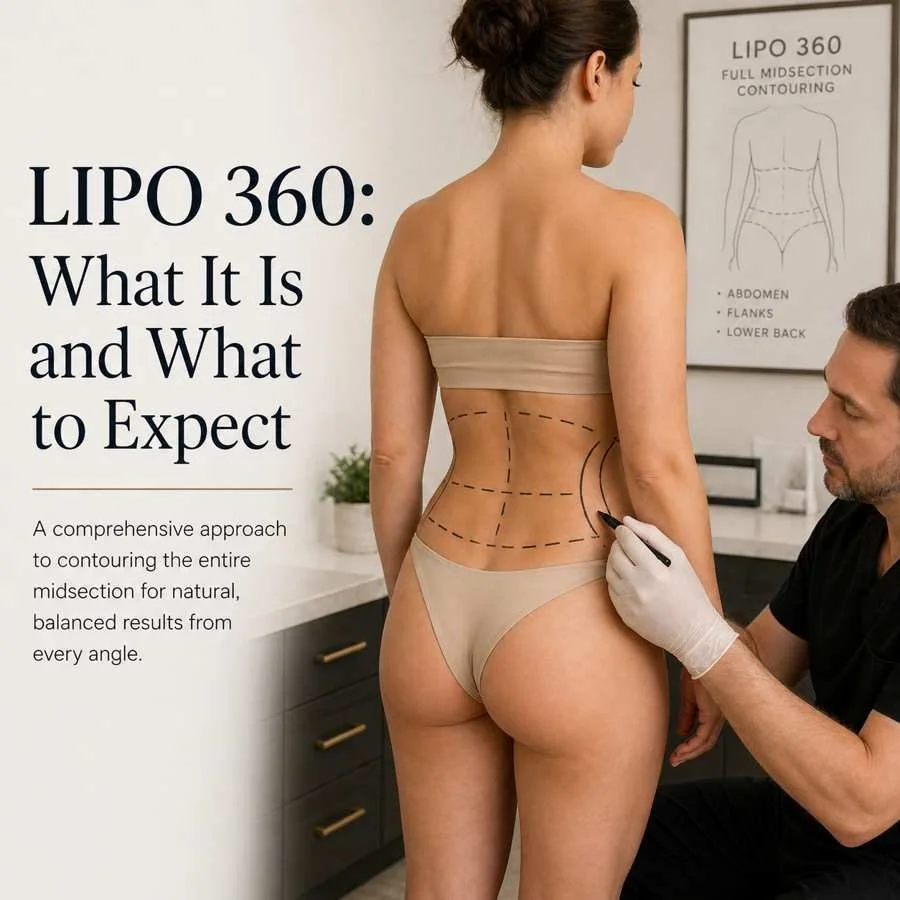
Lipo 360 is circumferential liposuction of the midsection. The "360" refers to the fact that fat is removed from all sides of the torso in a single surgical session rather than targeting one isolated area. A standard Lipo 360 procedure addresses some combination of the upper and lower abdomen, the waist, the flanks, and the lower back, treating the entire midsection as a unified aesthetic zone rather than a collection of separate problem areas.
This circumferential approach is what distinguishes Lipo 360 from traditional abdominal liposuction, which typically addresses only the front of the abdomen. When only the front is treated, the result can look disproportionate: a flatter stomach with unchanged flanks and lower back creates a visual imbalance that is immediately apparent from any angle other than straight on. Lipo 360 produces a result that looks natural and proportionate from every angle, which is why it has largely replaced single-area abdominal liposuction as the preferred approach for midsection contouring.
The procedure is performed under general anesthesia or deep sedation and typically takes two to four hours depending on the volume of fat being removed and the number of zones being treated. Incisions are small, typically three to five millimeters, and are placed at natural anatomical creases where they will be concealed once healed.
The Anatomy of the Midsection and Why It Matters for Results
Understanding why Lipo 360 produces the results it does requires a basic understanding of how fat is distributed in the midsection. Fat in this area sits in two primary layers: the superficial layer just beneath the skin, which is responsible for the visible softness and fullness of the midsection, and the deep layer closer to the abdominal wall, which contributes to overall volume.
The waist is defined by the relationship between the width of the ribcage above and the hips below, and the amount of fat in the lateral flanks and lower back that fills in that space between them. Removing fat from the front of the abdomen without addressing the flanks and lower back does not create waist definition, because the flanks are what create the hourglass narrowing. This is the anatomical reason that circumferential treatment consistently produces more dramatic and natural-looking results than single-zone treatment.
The lower back is an area that patients and some practitioners overlook but that has an outsized effect on the overall silhouette. Fat in the lower back creates the appearance of a flattened, boxy midsection even when the front of the abdomen is relatively flat. Addressing the lower back as part of a 360 treatment transforms the posterior silhouette in a way that dramatically changes how the body looks in clothing and from behind.
Who Is a Good Candidate for Lipo 360
Lipo 360 is a contouring procedure, not a weight loss tool. This distinction is not a formality. It directly affects who is and is not a good candidate and what realistic results look like.
The ideal candidate is an adult who is at or within approximately ten to fifteen pounds of a stable, healthy weight and has localized fat deposits in the midsection that have proven resistant to diet and exercise. This is the patient whose overall body composition is healthy but whose fat distribution, driven largely by genetics, concentrates in the waist, flanks, and abdomen in a way that no amount of training or dietary discipline changes significantly.
Good skin elasticity is the other major candidacy factor. When fat is removed from beneath the skin, the skin must contract and retract to adhere to the new underlying contour. Patients with good skin elasticity, typically younger patients or those without a history of significant weight fluctuation or pregnancy-related skin changes, retract cleanly and produce the smooth, tight result that Lipo 360 is known for. Patients with significantly reduced skin elasticity may need skin removal as part of the procedure, meaning a tummy tuck component, to achieve a comparable result.
Patients who are significantly overweight are not ideal candidates for Lipo 360 as a standalone procedure. The volume of fat that can be safely removed in a single session has established limits for patient safety, and attempting to use Lipo 360 as a primary weight reduction method produces inferior results and higher risk. The right sequencing for patients who have significant weight to lose is to reach a stable goal weight first, maintain it for several months, and then evaluate what residual contouring would benefit from surgical intervention.
Lipo 360 vs. Tummy Tuck: Understanding the Difference
One of the most common questions patients have when researching Lipo 360 is how it compares to a tummy tuck. They address overlapping concerns but in fundamentally different ways.
Lipo 360 removes fat. It does not address excess skin or the abdominal muscles. A tummy tuck removes excess skin, tightens the abdominal muscles if they have separated (a condition called diastasis recti, which is common after pregnancy), and repositions the navel. It typically includes some liposuction as part of the procedure but is primarily a skin and muscle procedure rather than a fat removal procedure.
The right choice between the two depends on what the patient's anatomy actually requires. Patients with good skin tone and primarily a fat volume concern are typically best served by Lipo 360. Patients with significant skin laxity, muscle separation, or significant post-pregnancy changes to the abdominal wall typically need a tummy tuck to achieve a satisfying result, because liposuction alone will not address the skin and muscle issues. Many patients benefit from a combination, with tummy tuck and Lipo 360 performed together for comprehensive midsection transformation.
A thorough pre-operative evaluation is the only way to determine which approach is appropriate for a specific patient's anatomy. Any practice that recommends one procedure over another without a proper in-person assessment is not giving you a clinically valid recommendation.
Lipo 360 as Part of a Broader Body Contouring Plan
Lipo 360 is frequently performed as a standalone procedure, but it is also one of the most common components of more comprehensive body contouring plans. It is a standard element of a mommy makeover, where it addresses midsection fat alongside breast and other body changes from pregnancy. It is also combined with a Brazilian Butt Lift in patients who want to both slim the waist and add volume to the buttocks, with the fat removed from the midsection transferred to the buttock area.
Understanding how Lipo 360 fits into a larger plan, rather than viewing it in isolation, often changes the scope and cost of what a patient ultimately decides to pursue. This is another reason why a thorough consultation matters more than any amount of online research.
What the Procedure Involves
On the day of surgery, you will arrive at the facility having followed pre-operative fasting instructions, typically nothing to eat or drink for eight hours before your procedure. After check-in and pre-operative preparation, anesthesia is administered and the treatment areas are marked. The tumescent solution, a mixture of saline, lidocaine, and epinephrine, is injected into each treatment zone. This solution numbs the area, constricts blood vessels to reduce bleeding, and makes the fat easier to remove.
Small incisions are made at the planned entry points and the cannula is inserted to break up and remove fat. The procedure addresses each zone of the 360 treatment area in turn, with the patient repositioned as needed to allow access to the flanks and lower back. The volume removed, the distribution of that removal, and the specific zones treated are all determined by the pre-operative plan developed during your consultation.
Once fat removal is complete, incisions are closed and the compression garment is applied before you leave the operating room. The garment is in place before you are awake. You will be monitored in recovery for one to two hours before being discharged into the care of your designated support person.
Recovery: What to Expect
Lipo 360 has the most involved recovery of the single-procedure liposuction options because of the circumferential treatment zone and the larger total volume of fat typically removed. Patients should plan for the following:
First week: Significant swelling, bruising, and soreness throughout the treated area. Compression garment worn 23 hours a day. Light walking encouraged from day one for circulation. Rest with upper body slightly elevated. Drainage of tumescent fluid from incision sites in the first 48 hours is normal.
Weeks two to four: Swelling begins to reduce but remains significant. Most patients return to desk work within one week. Compression garment continues. Lymphatic drainage massage typically begins around week one to two and is strongly recommended weekly for four to six weeks. Light cardio may be introduced around week four with clinical clearance.
Weeks four to six: Compression garment transitions to daytime only. Meaningful waist definition becomes visible. Six-week appointment clears patients for return to full exercise.
Months two to six: Results continue to develop as residual deep swelling resolves and skin completes retraction. The full result, including maximum waist definition and skin smoothness, is typically visible at five to six months. Some patients with larger volume procedures see continued improvement through month nine.
For a detailed breakdown of recovery by week, including nutrition guidance and activity protocols, the knowledge base articles on liposuction recovery and preparing for liposuction cover those topics in depth.
What Results Are Realistic
Lipo 360 consistently produces dramatic improvements in waist definition and overall midsection silhouette in appropriately selected patients. The results are permanent in the sense that the fat cells removed do not regenerate. The remaining fat cells throughout the body retain the ability to expand with weight gain, so maintaining a stable weight after the procedure is essential to preserving the result long term.
The American Society of Plastic Surgeons provides clinical guidance on liposuction outcomes and candidacy that is useful context for patients evaluating realistic expectations for circumferential body contouring procedures.
Patients who come in at a stable weight, have good skin elasticity, follow their post-operative protocol consistently, and maintain their weight after surgery consistently report high satisfaction with Lipo 360 results at one, two, and five years post-procedure.
The Adonis Approach to Lipo 360
At Adonis Plastic Surgery in Torrance, Lipo 360 is performed by board-certified plastic surgeons within a clinical framework built around individualized planning and structured post-operative care. The consultation process evaluates anatomy thoroughly, establishes realistic expectations, and develops a surgical plan specific to each patient's body rather than applying a one-size approach to a procedure that is inherently about precision and proportion.
Post-operative care is managed at the clinic level throughout recovery. Follow-up appointments are structured, the team is accessible between visits, and the clinical oversight does not end when you leave the operating room.
For patients working through the financial planning side of a procedure, our payment plans and financing options are available to review as part of the overall planning process.
Ready to Find Out If Lipo 360 Is Right for You?
The best way to determine whether Lipo 360, a tummy tuck, a combination of both, or a different approach altogether is the right fit for your anatomy and goals is a thorough in-person consultation at Adonis Plastic Surgery.
Adonis Plastic Surgery serves patients throughout the South Bay, including Torrance, Redondo Beach, Palos Verdes, El Segundo, Manhattan Beach, Long Beach, Carson, Gardena, and surrounding communities.