
Otoplasty
(Ear Pinning & Ear Reshaping)
Otoplasty reshapes or repositions prominent, protruding, asymmetric, or overly large ears so they sit in better proportion with the face and head. The goal is not to flatten the ears against the scalp. It is to preserve normal contours while reducing unwanted prominence and improving balance.[1]

What otoplasty actually changes.
Otoplasty improves the shape, position, or proportion of the external ear. For prominent ears, correction may involve creating or strengthening the antihelical fold, reducing or repositioning enlarged conchal cartilage, or combining techniques according to the anatomy.[2]
The operation can also improve selected ear-shape asymmetries, poorly defined folds, enlarged conchal cartilage, and overly large ears. There is no single universally superior technique; recent systematic reviews support matching the operation to the specific cartilage problem and note that higher-quality long-term comparative evidence is still needed.[3]
Adonis performs otoplasty at our Torrance surgical facility for patients from Redondo Beach, Long Beach, Palos Verdes, Manhattan Beach, El Segundo, San Pedro, Gardena, Carson, and throughout the South Bay and greater Los Angeles area.
“Ear pinning” is not one maneuver.
Prominent ears can come from different parts of the cartilage. A strong surgical plan identifies which structure is responsible instead of pulling every ear backward in the same way.
Antihelical fold
When the natural antihelical fold is weak or underdeveloped, the upper ear can flare outward. Sutures or cartilage-shaping techniques may be used to create a more natural fold.
Conchal cartilage
A deep or enlarged conchal bowl can push the ear outward from its base. The surgeon may reposition or reduce selected conchal cartilage depending on the anatomy.
Ear-to-head relationship
The distance and angle between the ear and scalp matter. Concha-to-mastoid sutures can be used in selected cases to reposition the ear closer to the head without over-flattening it.
The ears should look less prominent, not “pinned flat.”
An overcorrected ear can look unnatural when the central ear is pulled too close to the head, the upper and lower poles do not match, or normal folds are distorted. Otoplasty is a three-dimensional balancing procedure, not simply a measurement of how close the ear sits to the scalp.
A natural result maintains visible ear contours from the front, keeps both sides appropriately balanced, and preserves enough projection that the ear still looks anatomically normal. ASPS specifically emphasizes avoiding an unnatural “pinned back” appearance.[2]
The best result is usually quieter than patients expect: the ears stop drawing attention, while the face becomes the focus.
Otoplasty is not only a childhood procedure.
Otoplasty can be considered in children, teenagers, and adults. ASPS notes that children are generally considered around age five or when the ear cartilage is stable enough for correction, while teenagers and adults should be healthy, have specific goals, and be able to participate willingly in the decision and recovery.[4]
Adult otoplasty
Adults can have ear reshaping when they are healthy enough for surgery and have a specific concern such as projection, asymmetry, or ear size.
Teen otoplasty
For younger patients, the decision should be voluntary, well understood, and supported by appropriate maturity and ability to follow postoperative instructions.
Pediatric otoplasty
Children are generally considered only after the ear cartilage is sufficiently stable for correction, often around age five or later, and when the child can cooperate with recovery.
The technique should match the cartilage problem.
Most otoplasty incisions are placed behind the ear. From there, the surgeon can reshape cartilage, create a stronger antihelical fold, reposition the conchal bowl, remove selected cartilage when appropriate, and use internal sutures to hold the new shape.
Antihelical fold correction
When the upper ear lacks a defined antihelical fold, the surgeon can create or strengthen that fold with sutures, cartilage shaping, or a combination.
- Targets upper-ear prominence
- Designed around existing cartilage thickness and stiffness
- Aims to preserve smooth natural contours
- Can be combined with conchal repositioning
Conchal repositioning
When the ear projects because the conchal bowl is deep or sits too far from the head, sutures and, in selected cases, cartilage reduction may be used to reposition the base of the ear.
- Targets the central ear-to-head relationship
- May reduce excessive ear projection
- Often combined with fold correction
- Should avoid excessive flattening against the scalp
How ear pinning surgery is planned and performed.
The surgeon evaluates each ear separately and then together, looking at projection, antihelical fold, conchal depth, upper and lower pole position, earlobe relationship, size, asymmetry, cartilage strength, skin, scars, and the result you want.
Otoplasty is commonly performed as outpatient surgery. Depending on age, procedure complexity, and the surgical plan, anesthesia may be local, intravenous sedation, or general anesthesia. Incisions are generally placed behind the ear and, when needed on the front surface, within natural folds.[2]
Map the cause of prominence
The surgeon determines whether the main issue is a weak antihelical fold, a deep conchal bowl, ear-to-head distance, size, asymmetry, or a combination.
Plan both ears as a pair
Exact symmetry does not exist naturally, but the ears should be balanced in projection, fold shape, and upper-to-lower positioning.
Reshape and reposition cartilage
Cartilage is folded, scored, repositioned, reduced, or secured with sutures according to the anatomy rather than using one standardized maneuver.
Protect the new ear position
Dressings and later a supportive headband may be used to protect the ears while swelling decreases and the new cartilage position stabilizes.
If your ears have always felt too prominent, too wide, uneven, or out of proportion, the most useful first question is which part of the cartilage is creating the appearance.
REQUEST MY CONSULTATIONLook at ear position from the front, not only from behind.
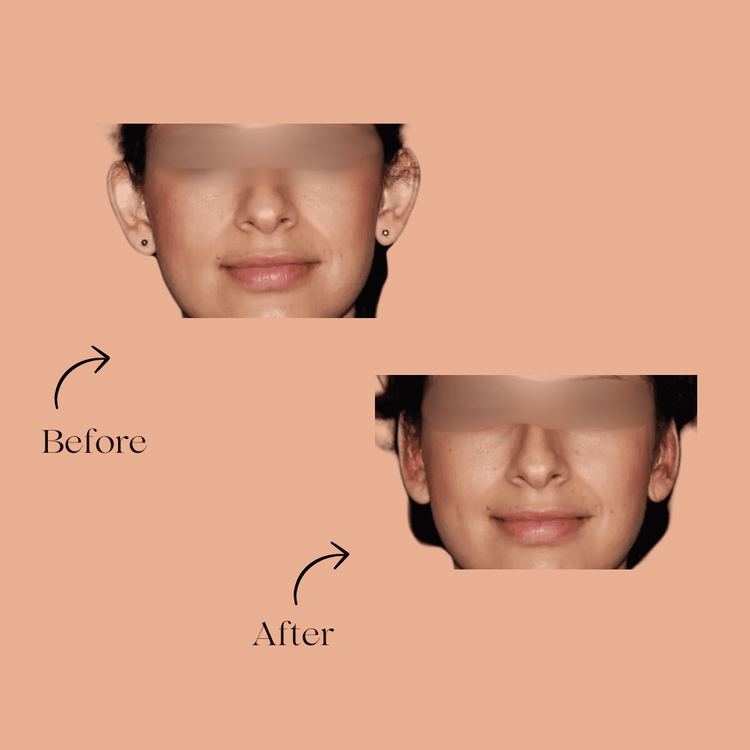
Individual results vary. Photos are shared with patient consent. Cartilage stiffness, ear anatomy, asymmetry, technique, scar tissue, healing, and postoperative protection can affect the final result.
Earlobe surgery is related, but it is not the same procedure.
Otoplasty primarily reshapes or repositions the cartilage-bearing outer ear. Earlobe repair treats a torn, stretched, split, or damaged earlobe, while earlobe reduction removes selected soft tissue when the lobe itself is too large or elongated.
Those concerns can sometimes be addressed at the same time, but they are different operations. Otoplasty primarily changes the cartilage-bearing ear, while earlobe repair or reduction treats the soft-tissue lobe itself.
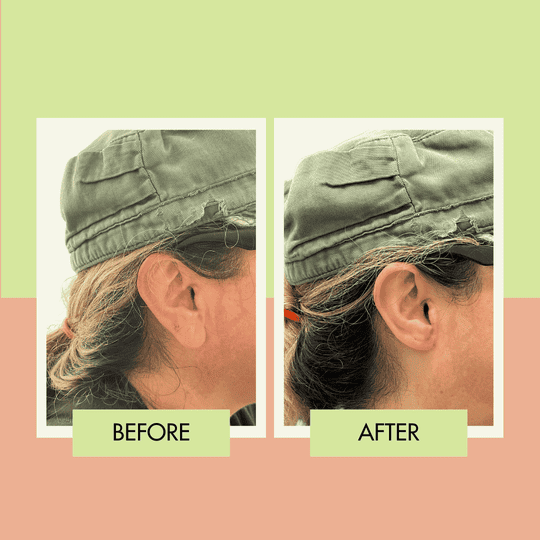
Otoplasty is precise cartilage surgery, not simply “pinning” the ears back.
Potential complications include bleeding or hematoma, infection, asymmetry, pain, numbness or sensation changes, poor wound healing, unfavorable scarring, contour irregularity, suture irritation or extrusion, recurrence of prominence, overcorrection, and the possibility of revision surgery.[6]
Recent reviews report low overall recurrence and revision rates across modern techniques, but outcomes vary by anatomy, technique, follow-up, and how complications are defined. No method eliminates recurrence or suture-related problems entirely.[7]
The goal is enough correction to reduce prominence while preserving natural folds, appropriate projection, skin viability, and realistic side-to-side balance.
Most patients return to normal routines before the ears are fully healed.
Swelling, tenderness, tightness, bruising, numbness, and temporary asymmetry can occur early. Dressings help protect the new ear position during initial healing, and avoiding excessive pressure, bending, or trauma remains important even after the patient feels physically comfortable.[5]
Dressings and swelling
The ears feel sore and tight. Keep the head elevated, protect the dressings, and avoid pressure or sleeping directly on the ears.
Work or school often resumes
Many patients return to work or school around this point, depending on swelling, comfort, dressings, and the surgeon's instructions.
Headband protection may continue
A supportive headband is commonly used at night or during selected activities to protect the ears from bending while the tissues stabilize.
Activity expands
Contact sports and activities that can pull or bend the ears remain restricted until the surgeon confirms that healing is strong enough.
Most scars are designed to hide behind the ear.
Standard ear-pinning incisions are commonly placed in the crease behind the ear. When a front-surface incision is needed, it can often be positioned within a natural fold. All incisions create permanent scars, but placement is designed to make them difficult to see in normal conversation.
Cartilage can be permanently repositioned, but healing still matters.
Otoplasty results are designed to be long-lasting. Recurrence, suture problems, scar changes, or cartilage memory can affect some patients, which is why appropriate technique and protecting the ears during recovery are important.
Ear reshaping with consultation, surgery, and follow-up connected to one Torrance practice.
Adonis Plastic Surgery is a QUAD A-accredited outpatient surgical facility at 2557 Pacific Coast Highway, Torrance, CA 90505. Consultation, ear evaluation, surgical planning, procedure-day care, and postoperative follow-up are coordinated through the Torrance practice.
We serve patients throughout Torrance, Redondo Beach, Long Beach, Palos Verdes, Rolling Hills Estates, Lomita, Harbor City, San Pedro, Gardena, Carson, Manhattan Beach, El Segundo, and the greater South Bay. Practical planning includes transportation, dressings, sleeping position, school or work timing, headband use when recommended, exercise restrictions, and protecting the ears from pressure or impact during healing.
Otoplasty cost in Torrance and Los Angeles.
Price depends on whether one or both ears are treated, the cartilage problem being corrected, the amount of reshaping or reduction, anesthesia, facility requirements, age, prior surgery, and whether a separate earlobe procedure is included.
Ear Pinning (Otoplasty) at Adonis
$2,500 – $5,500This is the current published Adonis range for otoplasty. Your final itemized quote is based on the anatomy, procedure complexity, anesthesia, facility requirements, and exact surgical plan.
Financing available
Qualified patients may use available payment-plan options for eligible self-pay surgical costs. Approval, interest, eligibility, and repayment terms are determined by the financing provider.
VIEW PAYMENT PLANSEarlobe repair or reduction is a separate procedure and receives its own procedure-specific quote when it is not part of the otoplasty plan.
Independent guidance and current evidence used for patient education.
These sources support general education about otoplasty anatomy, candidacy, technique, recovery, risks, and outcomes. The modern literature describes multiple effective operations rather than one universally superior technique, so surgical planning should remain anatomy-specific.
American Society of Plastic Surgeons
Antihelical fold, conchal correction, incisions, sutures and natural positioning
2026 systematic review · PubMed
Children, teenagers and adults
Dressings, protection and follow-up
Recognized complications
2026 practical review · PubMed
Systematic review and meta-analysis · PubMed
2025 clinical review · PubMed
Common questions about ear pinning, prominent ears, recovery, scars, and cost.
What is otoplasty?
Otoplasty is cosmetic ear surgery that changes the shape, position, or proportion of the external ear. It is commonly performed to correct prominent or protruding ears and is often called ear pinning or ear reshaping surgery.
What is ear pinning surgery?
Ear pinning is a common form of otoplasty that repositions protruding ears closer to the head. The surgeon may create a stronger antihelical fold, reposition the conchal bowl, use internal sutures, reshape cartilage, or combine techniques according to the cause of prominence.
What causes ears to stick out?
Prominent ears commonly result from an underdeveloped antihelical fold, a deep or enlarged conchal bowl, excessive distance between the ear and scalp, or a combination of these anatomical features.
Can otoplasty make ears smaller?
Otoplasty can make prominent ears appear less visually dominant by repositioning them. When the ears are genuinely oversized, called macrotia, selected ear-reduction techniques may also be considered.
Can otoplasty correct one ear only?
Yes. Some patients have unilateral prominence or asymmetry. Even when only one ear is the main concern, both ears are evaluated because the goal is balance rather than treating one side in isolation.
Can otoplasty correct asymmetric ears?
It can improve differences in projection, fold shape, and selected structural asymmetries. Perfect mirror-image symmetry cannot be guaranteed because the ears and surrounding skull are naturally different from side to side.
What is the antihelical fold?
The antihelical fold is the curved cartilage fold just inside the outer rim of the ear. When it is weak or poorly defined, the upper ear can protrude more prominently from the side of the head.
What is conchal cartilage?
The conchal bowl is the deep central cartilage of the external ear around the ear-canal opening. An enlarged or deep concha can push the ear farther away from the scalp and may need to be repositioned or reduced during surgery.
What is adult otoplasty?
Adult otoplasty uses the same basic principles of ear reshaping and repositioning in an adult patient. Adults commonly seek treatment for prominent ears, ear asymmetry, or ear size that has bothered them since childhood.
What age can a child have otoplasty?
Children are commonly considered once the ear cartilage is sufficiently developed and stable for correction, often around age five or later. The child also needs to be healthy, cooperative, and able to participate willingly in the process and recovery.
Is otoplasty painful?
Discomfort, tenderness, tightness, swelling, and pressure are expected in the first several days. Pain experience varies, but most patients transition toward normal daily activity well before complete healing.
How long does otoplasty surgery take?
Many procedures take approximately one to three hours depending on whether one or both ears are treated, cartilage complexity, asymmetry, reduction, anesthesia, prior surgery, and any combined earlobe work.
What anesthesia is used for otoplasty?
Local anesthesia, intravenous sedation, or general anesthesia may be used depending on age, procedure complexity, patient comfort, health, facility setting, and surgeon recommendation.
Where are the incisions for ear pinning?
Incisions are commonly placed behind the ear within the natural crease. When a front-surface incision is needed, it is generally positioned within an existing fold to reduce visibility.
Will otoplasty leave scars?
Yes. Otoplasty is surgery, so incisions create permanent scars. They are typically positioned behind the ear or within natural folds and often become much less noticeable as they mature.
How long is otoplasty recovery?
Many patients return to work or school around one week, but swelling and tenderness continue improving for several weeks. Full activity, especially contact sports or activities that can bend the ears, returns later after surgeon clearance.
How long do I wear a headband after otoplasty?
Headband protocols vary. A supportive headband is often used after the initial dressing period and may continue at night for several weeks to protect the ears from accidental folding or pressure. Follow your surgeon's specific schedule.
How should I sleep after otoplasty?
Patients are commonly instructed to sleep on their back with the head elevated during early recovery and to avoid sleeping directly on the ears until the surgeon confirms it is safe.
When can I exercise after otoplasty?
Light walking begins early. Strenuous exercise returns gradually, while contact sports and activities that could strike, bend, or pull the ears remain restricted longer.
Are otoplasty results permanent?
The operation is designed to create a long-lasting cartilage position. Some degree of recurrence, suture-related change, scar behavior, or cartilage memory is possible, so results should not be described as an absolute lifetime guarantee.
Can otoplasty look natural?
Yes. Natural ear pinning preserves normal folds, avoids pulling the ear excessively close to the scalp, and balances the upper, middle, and lower ear so the result looks proportionate from both front and back views.
Is earlobe repair the same as otoplasty?
No. Otoplasty primarily reshapes and repositions the cartilage-bearing ear. Earlobe repair treats torn, split, stretched, or damaged soft tissue in the earlobe. Earlobe reduction reduces an overly large or elongated lobe.
Does insurance cover otoplasty?
Cosmetic ear pinning is generally self-pay. Some health plans may consider reconstructive treatment for selected congenital, traumatic, or medically necessary ear conditions, but requirements vary and coverage cannot be assumed without plan-specific review and authorization.
What are the risks of otoplasty?
Potential risks include bleeding or hematoma, infection, asymmetry, pain, numbness or sensation changes, poor wound healing, unfavorable scarring, contour irregularity, suture irritation or extrusion, recurrence of prominence, overcorrection, and the possibility of revision surgery.
How much does otoplasty cost in Torrance or Los Angeles?
Adonis currently publishes a $2,500 to $5,500 range for ear pinning surgery. Final pricing depends on the anatomy, whether one or both ears are treated, complexity, anesthesia, facility requirements, prior surgery, and any additional ear procedure.
Do you see otoplasty patients from Long Beach and outside Torrance?
Yes. Adonis Plastic Surgery is in Torrance and serves patients from Long Beach, Redondo Beach, Palos Verdes, Manhattan Beach, El Segundo, San Pedro, Gardena, Carson, Lomita, and throughout the South Bay and Greater Los Angeles.
Make the ears less noticeable without making them look operated on.
Meet with a board-certified plastic surgeon to review ear projection, cartilage folds, conchal depth, size, asymmetry, earlobe position, scars, recovery, and the degree of change you want. You will receive a clear recommendation based on the specific anatomy creating the prominence or imbalance.