
Breast Augmentation
in Torrance, CA
Breast augmentation at Adonis Plastic Surgery in Torrance increases or restores breast volume using silicone or saline implants. A strong result is not defined by cup size alone. It comes from matching implant width, projection, placement, existing tissue, nipple position, skin support, and the shape you want to your actual chest anatomy.[1]

What breast augmentation can change.
Breast augmentation can add volume, restore fullness lost after pregnancy or weight change, improve visible asymmetry, and change the relationship between the breasts and the rest of the torso. For some patients the goal is subtle restoration. For others it is a clearly fuller shape.
What implants do not reliably correct is significant breast sagging.[1] If the nipple and breast tissue have descended enough that adding volume would leave the breast looking fuller but still low, a breast lift or augmentation with lift may be the better operation.
Adonis performs breast augmentation at our Torrance surgical facility for patients throughout Redondo Beach, Palos Verdes, Manhattan Beach, El Segundo, Long Beach, San Pedro, and the greater South Bay and Los Angeles area.
Who tends to be a good candidate for breast augmentation?
A good plan begins with the breast you already have. Skin quality, breast width, nipple position, existing tissue, chest-wall shape, asymmetry, pregnancy plans, and the amount of volume you want all affect which operation makes sense.
Naturally smaller breast volume
You want more volume or proportion but do not have enough sagging to require a breast lift.
Volume loss after pregnancy or weight change
The breast has lost fullness, especially in the upper pole, but the skin and nipple position remain suitable for augmentation alone.
Breast asymmetry
Different implant sizes, profiles, pocket adjustments, or selective fat grafting may help improve visible differences between the breasts.
Silicone vs. Saline Breast Implants.
The right implant depends on how much volume and projection you want, the amount of natural breast tissue available for coverage, breast and chest dimensions, and how you feel about long-term implant monitoring.
Silicone breast implants
Silicone gel implants are prefilled and available in multiple widths, profiles, and volumes. They are commonly selected when a softer feel and reduced visible rippling are priorities, particularly in patients with thinner breast tissue.
Saline breast implants
Saline implants have a silicone shell and are filled with sterile saline after placement. Their fill volume can be adjusted during surgery, and rupture is usually easier to recognize because the implant deflates.
Prefer an implant-free approach? Breast fat transfer uses liposuction and your own tissue for a more modest volume increase or targeted contour refinement. For implant selection, read our saline vs. silicone breast implant guide.
The right implant is more than a number of cc's.
An implant's volume matters, but so do its base width and projection. Two implants with the same volume can look different if one is wider and lower-profile while the other is narrower and projects farther forward.
Your surgeon also considers chest width, rib-cage shape, the amount of existing breast tissue, skin stretch, nipple position, and how much upper-pole fullness you want. The goal is to select an implant that fits the breast envelope rather than forcing the breast to fit a requested cup size.
Where the implant sits matters as much as which implant you choose.
Breast implants may be placed above the pectoral muscle or partially/fully beneath it depending on anatomy and the surgeon's plan. Incision choice also affects access to the pocket, scar location, and which implant can be inserted safely.
Subglandular placement
The implant sits behind the breast tissue and above the pectoral muscle. This may be appropriate when there is enough natural tissue for coverage and the surgeon wants to avoid muscle-related movement.
Submuscular / dual-plane placement
The implant is placed partly or substantially beneath the pectoral muscle. This can provide additional upper implant coverage in selected patients, although recovery and implant movement with chest-muscle contraction may differ.
Incision location
Common approaches include the inframammary fold, the lower areolar border, and selected transaxillary approaches. Your surgeon recommends the incision that gives appropriate access for the implant and planned pocket.
An implant adds volume. It does not automatically lift a sagging breast.
If the nipple remains in an appropriate position and the main issue is lost or insufficient volume, breast augmentation alone may be enough. When the nipple and breast tissue have descended significantly, simply adding a larger implant can create a heavier breast without correcting the underlying sagging.
In those cases, the surgeon may recommend a breast lift with or without an implant. Patients addressing breast and abdominal changes after pregnancy may also consider a broader mommy makeover plan.
The correct question is not “How large an implant can I use?” It is “What combination of volume, position, and skin support will create the shape I am actually asking for?”
How breast augmentation is planned and performed.
Implant breast augmentation is performed with an anesthesia plan selected for the patient and operation; general anesthesia is commonly used.[3] The surgeon creates the planned incision, develops an implant pocket either above or below the pectoral muscle, places the selected implant, confirms position and symmetry, and closes the incision in layers.
The exact technique varies because breast width, tissue thickness, asymmetry, nipple position, implant dimensions, and prior surgery are different from patient to patient. Your surgical plan should explain those choices before surgery day rather than presenting one technique as correct for everyone.
Consultation and sizing
Your surgeon evaluates breast anatomy, skin and tissue quality, asymmetry, implant dimensions, desired shape, health history, and whether a lift is needed.
Incision and pocket creation
The selected incision is made and the implant pocket is developed according to the planned placement and your anatomy.
Implant placement and symmetry check
The implants are placed and the surgeon evaluates position, fold level, projection, and visible symmetry before closure.
Closure and recovery
Incisions are closed, a supportive surgical bra is placed when indicated, and you go home with written aftercare instructions and scheduled follow-up.
Not sure whether your goal is better served by breast implants, breast fat transfer, a breast lift, or a combination? That decision should be based on your breast anatomy and the shape you want, not on a trend or cup-size target.
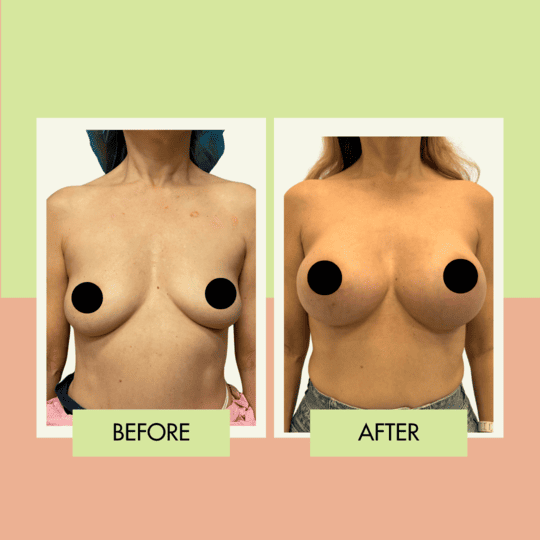
REQUEST MY CONSULTATIONBreast augmentation before and after.
Compare more than breast size. Look at breast width, projection, cleavage, nipple position, symmetry, upper-pole fullness, and whether the result fits the patient's torso. Individual anatomy strongly influences what can be achieved.
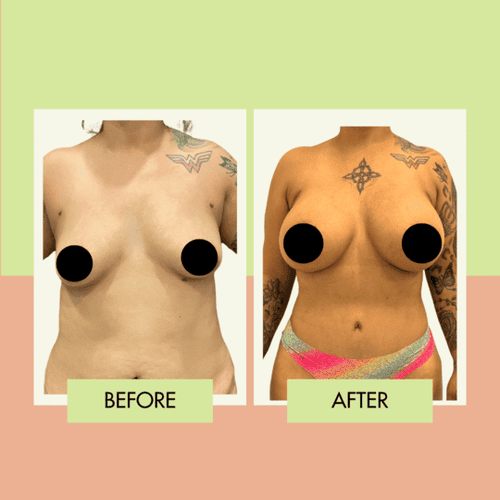
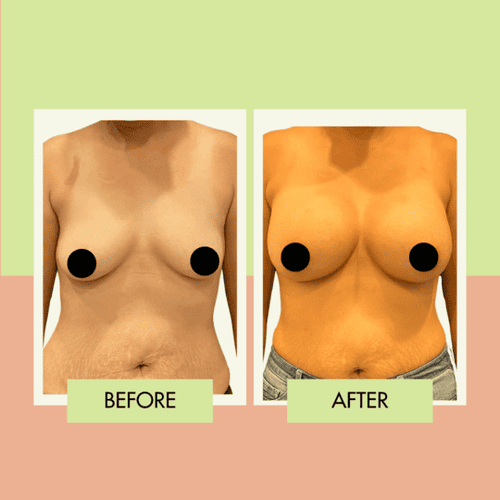
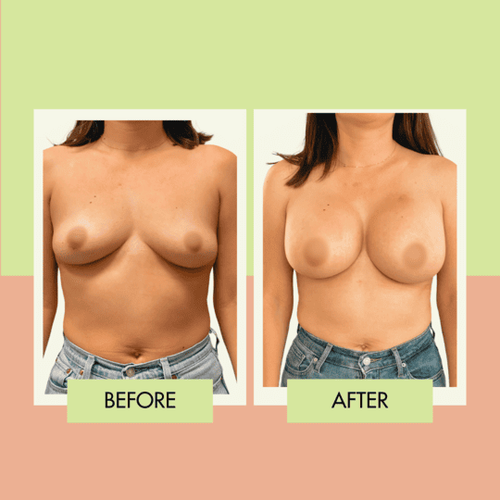
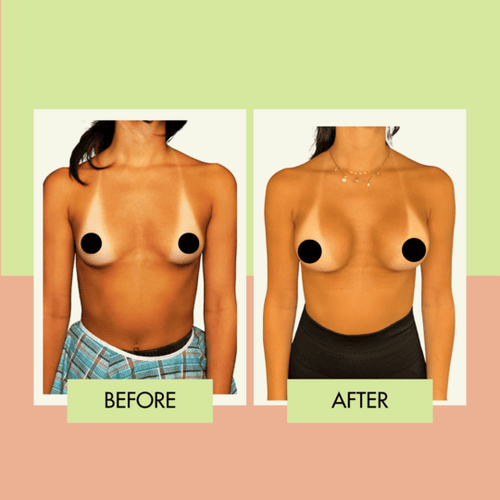
Individual results vary. Photos are shared with patient consent. Implant type, dimensions, placement, starting tissue, skin quality, and healing all affect the final appearance.
Breast Augmentation Recovery: What to Expect.
Soreness, swelling, bruising, chest tightness, and temporary sensory changes can occur early. Recovery instructions and activity progression vary by operative plan and surgeon.[4] Many patients return to desk work within about a week, while strenuous exercise and heavy upper-body activity remain restricted longer.
Tightness and soreness
The chest may feel tight and the implants may initially sit high. Walking is encouraged while lifting, pushing, pulling, and strenuous activity are limited.
Desk work often resumes
Many patients can return to sedentary work as discomfort improves, although swelling and breast tightness remain normal.
Activity expands gradually
Exercise and heavier activity return only after surgeon clearance. Implant placement and any combined breast lift can change this timeline.
Implants continue to settle
Swelling decreases, the breast softens, and implant position becomes easier to judge as the pocket and surrounding tissues mature.
For more detail, read our breast augmentation recovery guide and our guide to sleeping after breast augmentation.
Breast implants are medical devices, not lifetime devices.
There is no universal replacement date, but implants require long-term awareness and some patients eventually need breast implant revision or removal because of rupture, capsular contracture, implant position, aesthetic changes, or personal preference. FDA labeling includes a boxed warning and a patient decision checklist so patients understand device-specific risks before surgery.[6]
Future surgery is possible
Implant exchange, downsizing, pocket correction, capsule surgery, or removal may become relevant over time. Our breast implant revision page explains these options in detail.
Silent rupture matters
Silicone rupture can occur without obvious symptoms. Ultrasound or MRI can be used to evaluate implant integrity.[7]
Screening is ongoing
FDA-approved silicone implant labeling commonly recommends first ultrasound or MRI at 5–6 years, then every 2–3 years thereafter for asymptomatic rupture screening.[8]
Breast augmentation with consultation, surgery, and follow-up connected to one plan.
Adonis Plastic Surgery is a QUAD A-accredited outpatient surgical facility at 2557 Pacific Coast Highway, Torrance, CA 90505. Consultation, operative planning, surgery-day care, and postoperative follow-up are coordinated through the Torrance practice.
We serve patients throughout Torrance, Redondo Beach, Palos Verdes, Rolling Hills Estates, Lomita, Harbor City, San Pedro, Gardena, Carson, Manhattan Beach, El Segundo, Long Beach, and the greater South Bay. For breast augmentation, practical planning includes help at home, driving, work demands, lifting restrictions, exercise, implant monitoring, and future breast screening.
Breast implant augmentation cost in Torrance and Los Angeles.
Pricing depends on implant type, surgical plan, anatomy, asymmetry, anesthesia, facility requirements, and whether another breast procedure is performed at the same time. Your final itemized quote is prepared after the surgeon evaluates your anatomy and goals.
Breast Augmentation with Implants — Typical Range
$9,000 – $11,700This is a typical planning range, not an absolute maximum for every implant type. Adonis currently lists silicone implant procedures at $9,500–$12,000 and saline implant procedures at $9,000–$11,500 depending on the final surgical plan.
Considering breast fat transfer instead?
Fat-transfer augmentation has a different surgical workflow, donor-site requirements, recovery, and pricing. Review the dedicated Breast Fat Transfer page rather than comparing it as though it were simply another implant type.
When comparing implant-augmentation quotes, compare the implant type, surgeon, anesthesia, facility, implant costs, postoperative care, and whether another procedure such as a breast lift is included.
Common questions about breast implants and augmentation.
What is breast augmentation?
Breast augmentation can be performed with implants or transferred fat. This page focuses on implant-based augmentation using silicone or saline implants. Patients specifically seeking augmentation without implants can review our dedicated Breast Fat Transfer page.
Which surgeons perform breast augmentation at Adonis?
Breast augmentation at Adonis is performed by board-certified plastic surgeons Dr. Shana S. Kalaria and Dr. Joshua Y. Jacobson. Dr. Kalaria medically reviewed this page.
What is the difference between silicone and saline breast implants?
Both have a silicone outer shell. Saline implants are filled with sterile saltwater after insertion, while silicone implants are prefilled with silicone gel. They differ in feel, rippling characteristics, incision requirements, rupture behavior, available dimensions, and long-term monitoring considerations.
How do I choose the right breast implant size?
Implant selection should consider breast and chest width, existing tissue, skin stretch, implant profile, projection, and your desired shape. Cup sizes are not standardized, so choosing an implant by cup-size goal alone can be misleading.
What does breast implant profile mean?
Profile describes how far an implant projects forward relative to its base width. A lower-profile implant is generally wider for a given volume, while a higher-profile implant is narrower and projects farther forward. Your chest and breast dimensions determine which profiles are realistic.
Is it better to place breast implants over or under the muscle?
Neither placement is universally better. Above-muscle placement may be appropriate when there is sufficient natural tissue for coverage. Submuscular or dual-plane placement may provide additional upper implant coverage in thinner patients. Each option has different aesthetic and recovery tradeoffs.
Where are breast augmentation scars located?
Common incision locations include the inframammary fold beneath the breast, the border of the areola, and selected transaxillary approaches. The incision used depends on implant type, implant dimensions, anatomy, prior scars, and the surgeon's preferred access for precise pocket creation.
Do I need a breast lift with implants?
If the nipple and breast tissue have descended significantly, an implant alone may add volume without correcting the sagging. A breast lift can reposition the breast and nipple while an implant adds volume. Your surgeon determines whether augmentation alone or augmentation with mastopexy better matches your anatomy.
How is fat transfer breast augmentation different from implants?
Fat transfer uses liposuction to harvest your own fat and graft selected volume into the breasts. It generally provides a more modest volume increase and requires enough donor fat, while implants offer a wider and more predictable range of added volume and projection. See our Breast Fat Transfer in Torrance page for candidacy, donor areas, recovery, risks, and pricing.
I already have breast implants and want to change them. Is this the right page?
If you already have implants and are considering exchange, downsizing, removal, rupture, capsular contracture, malposition, or another correction, start with our Breast Implant Revision in Torrance page. This page is focused on primary implant augmentation.
How long does breast augmentation surgery take?
Implant breast augmentation commonly takes about one to two hours. Operative time can increase when the surgery includes a breast lift, significant asymmetry correction, fat grafting, or another procedure.
How long is breast augmentation recovery?
Many patients return to desk-based work within five to seven days. Soreness and swelling can last longer, and strenuous activity is generally restricted for several weeks. Implant position and breast shape continue to settle for several months.
When can I exercise after breast augmentation?
Walking usually begins early, but vigorous exercise and heavy upper-body activity are restricted during healing. Many patients gradually return to broader activity over four to six weeks, but your surgeon's clearance and the specific operation take priority over a generic timeline.
When can I sleep on my side after breast augmentation?
Side sleeping is commonly restricted during the early healing period because pressure can affect comfort and the developing implant pocket. Return to side sleeping when your surgeon clears you based on implant placement, healing, and comfort rather than relying on a fixed week.
Can I breastfeed after breast augmentation?
Some patients are able to breastfeed after breast augmentation, but no surgical technique can guarantee future breastfeeding. Existing anatomy, pregnancy-related factors, incision choice, and the effect of surgery on breast tissue or ducts can all influence lactation.
Can I still have mammograms with breast implants?
Yes. Tell the imaging facility that you have breast implants so the technologist can use appropriate implant-displacement views when indicated. Continue routine breast-cancer screening according to the recommendations of your health care provider.
How long do breast implants last?
Breast implants are not considered lifetime devices, but there is no universal expiration date requiring automatic replacement at a specific number of years. Some patients keep implants for many years without surgery, while others need breast implant revision sooner because of complications, implant changes, or aesthetic preferences.
Do silicone breast implants need MRI or ultrasound screening?
Current FDA guidance recommends ultrasound or MRI screening for silent silicone implant rupture beginning about five to six years after placement and then every two to three years thereafter. Your surgeon or other health care provider can help determine the appropriate surveillance plan.
What is capsular contracture?
The body normally forms a scar-tissue capsule around a breast implant. Capsular contracture occurs when that capsule tightens excessively, which can make the breast feel firm, distort the implant position or shape, and sometimes cause pain. More significant cases may require breast implant revision surgery.
What are the risks of breast implants?
Risks include bleeding, infection, changes in nipple or breast sensation, scarring, capsular contracture, implant rupture or deflation, rippling, implant malposition, asymmetry, persistent pain, fluid collections, anesthesia complications, and possible revision surgery. Breast implants are also associated with BIA-ALCL, and the FDA has received reports of squamous cell carcinoma and other lymphomas developing in the capsule around breast implants. These rare but serious risks should be discussed as part of informed consent.[5]
How much does breast augmentation cost in Torrance or Los Angeles?
Adonis lists a typical implant-augmentation planning range of $9,000–$11,700. Implant-specific pricing can extend above that range: silicone procedures are listed at $9,500–$12,000 and saline procedures at $9,000–$11,500. Your final itemized quote depends on the surgical plan. Implant-free augmentation is priced and explained separately on our Breast Fat Transfer page.
Can breast augmentation be part of a mommy makeover?
Yes. Breast augmentation may be combined with a breast lift, tummy tuck, liposuction, or other selected procedures as part of a mommy makeover when your surgeon determines the total surgical plan is appropriate for your health and recovery needs.
Do you see breast augmentation patients from outside Torrance?
Yes. Adonis Plastic Surgery is in Torrance and serves patients from Redondo Beach, Palos Verdes, Manhattan Beach, El Segundo, Long Beach, San Pedro, Gardena, Carson, Lomita, and throughout the South Bay and Greater Los Angeles.
Clinical information reviewed against independent medical sources.
This page was medically reviewed by Shana S. Kalaria, MD, MBA, an American Board of Plastic Surgery-certified plastic surgeon, on September 11, 2026. These references support general educational information about candidacy, implant options, technique, recovery, risk, and long-term device monitoring. They do not replace individualized medical advice.
American Society of Plastic Surgeons
American Society of Plastic Surgeons
American Society of Plastic Surgeons
American Society of Plastic Surgeons
American Society of Plastic Surgeons
U.S. Food & Drug Administration
U.S. Food & Drug Administration
U.S. Food & Drug Administration
Joshua Y. Jacobson, MD · ASPS profile
Choose the breast shape first. Then choose the implant that can create it.
Meet with one of our board-certified plastic surgeons to review breast width, tissue thickness, asymmetry, nipple position, implant dimensions, placement, recovery, long-term monitoring, and whether augmentation alone or a breast lift combination is more appropriate. You will receive a clear surgical recommendation and detailed quote before deciding whether to move forward.