

Brazilian Butt Lift
(BBL Fat Transfer)
A Brazilian Butt Lift uses your own fat to reshape the buttocks while liposuction contours the donor areas. The result depends on both parts of the operation: where volume is added and how the waist, flanks, abdomen, back, or thighs are sculpted around it. Because gluteal fat grafting has procedure-specific safety concerns, technique and injection plane are central to planning, not secondary details.[1]

What a Brazilian Butt Lift actually does.
A BBL, or gluteal fat grafting procedure, begins with liposuction. Fat is removed from selected donor areas, processed, and transferred into appropriate subcutaneous recipient tissue to improve shape, projection, proportion, or asymmetry.[1]
The procedure is not only about making the buttocks larger. Removing fat from the waist and flanks can change the apparent hip-to-waist relationship even before any fat is transferred. For many patients, that torso contouring is as important to the final silhouette as the amount of grafted fat.
Adonis performs BBL surgery at our Torrance surgical facility for patients throughout Redondo Beach, Palos Verdes, Manhattan Beach, El Segundo, Long Beach, San Pedro, Carson, and the greater South Bay and Los Angeles area.
For a broader introduction to the procedure, read our complete BBL guide.
Who tends to be a good candidate for BBL surgery?
A BBL requires more than simply wanting additional buttock volume. The surgeon has to evaluate your health, skin quality, body proportions, donor-fat availability, weight stability, and whether the requested change can be achieved safely with your own tissue.
Enough donor fat
You need harvestable fat in areas that can be contoured without compromising proportion. Lean patients may still qualify, but the amount available can limit the achievable volume.
Stable, sustainable weight
Large weight changes after surgery can alter both the donor areas and the transferred fat. A reasonably stable weight makes long-term contour more predictable.
Realistic shape goals
Bone structure, muscle, skin, hip width, gluteal shape and available fat all matter. Surgery can improve proportion, but it cannot reproduce every reference photo on every body.
Lean patients may be candidates, but the strategy is different.
“Skinny BBL” is an informal term for fat-transfer buttock contouring in a leaner patient with smaller donor-fat reserves. The operation still relies on liposuction and fat grafting; the difference is that the surgeon must be more selective about where fat is harvested and realistic about the amount of volume available.
Shape may matter more than size
For a lean patient, targeted contour changes around the waist, upper buttock, or hip transition can sometimes create a noticeable proportional change without a very large transfer.
Donor areas are limited
The surgeon cannot safely remove fat that is not there. Multiple small donor zones may be considered, but preserving smooth contours is more important than chasing a target number of cc's.
Expectations need to match anatomy
A lean patient seeking a dramatic increase may not have enough transferable fat for the requested volume. Your surgeon should tell you that before surgery rather than promising an unrealistic result.
The donor-area contour can change the result as much as the fat transfer.
A BBL is frequently planned with circumferential torso liposuction because the waist, flanks, abdomen, and lower back frame the buttocks. Removing selected fat from those areas can make the transferred volume appear more proportionate and can create a smoother transition around the entire torso.
Patients who want more comprehensive waist and back contouring should review our Lipo 360 page. Patients seeking more athletic definition rather than simply volume reduction can also explore HD liposuction.
More liposuction is not automatically better. Donor areas need to remain smooth, balanced, and safely treated. The surgical plan should be based on the whole silhouette rather than on harvesting the maximum possible amount of fat.
Injection plane and visualization are central safety questions.
Gluteal fat grafting carries procedure-specific risks, including potentially fatal fat embolism. Multi-society guidance supports keeping grafted fat in the subcutaneous tissue above the gluteal fascia and supports real-time ultrasound during injection to help confirm cannula position.[1]
Know where the fat is being placed
Current multi-society safety guidance supports gluteal fat placement in the subcutaneous tissue above the muscle fascia rather than intramuscular injection.[1]
Ask about real-time visualization
Real-time ultrasound can visualize the cannula during injection and help confirm the intended anatomic plane. Recent reviews support it as a useful safety adjunct, while also noting that much of the available evidence is observational rather than randomized.[2]
Choose the surgeon and facility carefully
Ask who is performing the operation, where it takes place, what credentials and privileges apply, what injection-plane safeguards are used, and how postoperative concerns are handled after you leave the facility.[1]
How BBL fat transfer is planned and performed.
BBL surgery combines liposuction with autologous fat grafting. The donor areas and recipient contour are marked as part of one silhouette plan. Fat is removed from selected areas, processed, and grafted into the planned subcutaneous recipient zones; current safety guidance emphasizes staying above the gluteal fascia during injection.[1]
Not every harvested fat cell survives transfer, so the final result cannot be judged from the immediate postoperative volume. The surviving fat establishes a blood supply over time while swelling in both the donor and recipient areas gradually resolves.
Body and donor-area evaluation
Your surgeon evaluates waist-to-hip proportion, buttock shape, hip contour, donor-fat availability, skin quality, asymmetry, health history, and the degree of change you want.
Liposuction and fat harvest
Fat is removed from the planned donor zones while those areas are sculpted as part of the overall result rather than treated simply as a source of graft material.
Fat processing and transfer
The harvested fat is prepared for grafting and transferred into the planned recipient areas to improve shape, projection, balance, or selected contour deficiencies.
Compression and pressure protection
Compression is used for the liposuction areas while direct pressure on newly grafted buttock areas is limited according to your surgeon's postoperative protocol.
Not sure whether your best result comes from BBL alone, Lipo 360 with fat transfer, or a more subtle Skinny BBL? The right plan depends on your proportions and the donor fat you actually have.
REQUEST MY CONSULTATIONBrazilian Butt Lift before and after.
Evaluate the entire silhouette, not just buttock size. A strong BBL result should make sense from the front, side, and back, with balanced donor-area contour, smooth transitions, appropriate projection, and a result that fits the patient's frame.
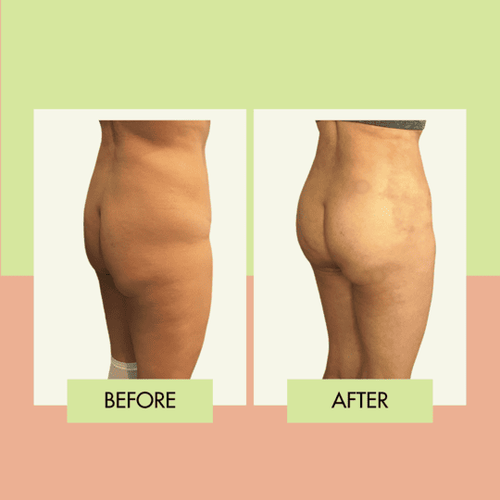
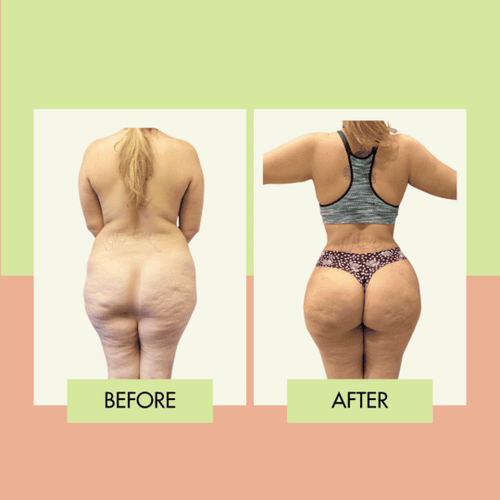
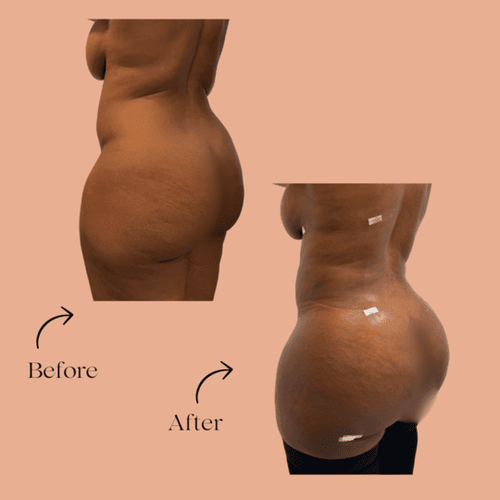
Individual results vary. Photos are shared with patient consent. Donor-fat availability, starting anatomy, liposuction pattern, fat retention, skin quality, healing, and weight changes influence the final result.
The first weeks are about healing two treatment zones at once.
BBL recovery combines the swelling and soreness of liposuction with the need to protect the newly grafted fat from unnecessary direct pressure. Your exact sitting, sleeping, compression, work, driving, and exercise instructions should come from your surgeon because they depend on the recipient areas and donor zones treated.
Swelling, walking, pressure protection
Expect bruising, soreness, drainage from liposuction access sites, and significant swelling. Short walks begin early while direct pressure on grafted areas is limited.
Daily activity becomes easier
Discomfort usually improves, but positioning and sitting restrictions may still affect work, driving, and normal routines. Follow the specific protocol your surgeon gives you.
Activity expands gradually
Exercise and unrestricted sitting return in stages after clinical clearance. Swelling in the donor areas remains even when you feel much more functional.
The stable contour becomes clearer
Residual swelling decreases and the retained grafted fat becomes easier to judge. Final shape should be evaluated after the early postoperative volume changes have settled.
For a more detailed timeline, read our BBL recovery guide, including sitting restrictions, positioning, swelling, compression, and the timeline for evaluating results.
Some transferred fat is naturally reabsorbed.[6]
The immediate postoperative buttock volume includes swelling and transferred fat that has not yet established a long-term blood supply. Some grafted fat is naturally reabsorbed during healing, which is why the first few days are not the final result.
Do not judge the first-week volume
Early swelling can make both donor and recipient areas look very different from the mature contour. Final assessment requires time.
Stable transferred fat behaves like fat
Fat that successfully establishes itself in the recipient area can enlarge or shrink with future weight change, just like fat elsewhere in the body.
Weight stability matters
Large weight gain or loss can change both the waist and buttock contour, even after the transferred fat has stabilized.
BBL, buttock implants, and a true buttock lift are not the same surgery.
Patients often use “butt lift” as a general term, but different procedures address different problems. A BBL adds and redistributes volume with fat transfer; a surgical buttock lift removes loose skin; implants add volume without requiring donor fat.
BBL / fat transfer
Best suited to patients who want buttock or hip contour enhancement and have appropriate donor fat available for liposuction and grafting.
Buttock lift after weight loss
If the dominant concern is hanging or substantially loose skin, adding fat does not remove that skin. A skin-excision body-contouring procedure may be more appropriate.
Buttock implants
Implants can create volume without donor fat but involve a different operation, scar pattern, implant-related risks, and recovery. They are not interchangeable with autologous fat grafting.
BBL planning, surgery, and follow-up connected to one Torrance practice.
Adonis Plastic Surgery is a QUAD A-accredited outpatient surgical facility at 2557 Pacific Coast Highway, Torrance, CA 90505. Consultation, body-contouring planning, surgery-day care, and postoperative follow-up are coordinated through the Torrance practice.
We serve patients throughout Torrance, Redondo Beach, Palos Verdes, Rolling Hills Estates, Lomita, Harbor City, San Pedro, Gardena, Carson, Manhattan Beach, El Segundo, Long Beach, and the greater South Bay. BBL recovery planning should account for transportation, positioning, work demands, compression, mobility, follow-up, and any travel required after surgery.
Brazilian Butt Lift cost in Torrance and Los Angeles.
BBL pricing depends on the number and extent of liposuction donor areas, the amount of body contouring required, operative complexity, anesthesia, facility requirements, and the individualized fat-transfer plan.
Brazilian Butt Lift at Adonis
$10,500 – $18,000This is the current published Adonis range for Brazilian Butt Lift surgery. Your final itemized quote is based on the donor areas, liposuction extent, fat-transfer plan, anesthesia, facility requirements, and overall surgical complexity.
Financing available
Qualified patients may use available payment-plan options for eligible surgical costs. Approval, interest, eligibility, and repayment terms are determined by the financing provider.
VIEW PAYMENT PLANSWhen comparing BBL quotes, confirm what donor areas are included, how much liposuction is planned, who performs the surgery, the facility and anesthesia structure, postoperative garments and follow-up, and what safety protocols are used during gluteal fat grafting.
Common questions about BBL fat transfer.
What is a Brazilian Butt Lift?
A Brazilian Butt Lift, or BBL, is a body-contouring procedure that removes fat from selected donor areas with liposuction and transfers prepared fat into the buttocks or surrounding contour zones to change shape, proportion, projection, or symmetry.
Who performs Brazilian Butt Lift surgery at Adonis?
Brazilian Butt Lift surgery at Adonis is performed by board-certified plastic surgeon Joshua Y. Jacobson, MD. His Adonis practice includes BBL, liposuction, Lipo 360, tummy tuck, and other body-contouring procedures. Dr. Jacobson medically reviewed this page.
Does a BBL use implants?
No. A traditional BBL uses your own fat rather than a buttock implant. The procedure combines liposuction with autologous fat grafting.
Where does the fat for a BBL come from?
Common donor areas include the abdomen, waist, flanks, lower back, and thighs. The surgeon chooses donor zones based on where usable fat exists and whether removing it will improve rather than disrupt your overall proportions.
Can I combine BBL with Lipo 360?
Yes, when appropriate. Lipo 360 can contour the abdomen, waist, flanks, and back while providing donor fat for transfer. The combined plan changes both the torso and buttock contour and must be designed around the patient's anatomy and safe operative scope.
What is a Skinny BBL?
Skinny BBL is an informal term for BBL surgery in a leaner patient with less donor fat. The procedure still uses liposuction and fat transfer, but the achievable volume may be smaller and donor areas need to be selected more conservatively.
Do I have enough fat for a BBL?
That can only be determined after examining your body composition and donor areas. A patient may have enough fat for targeted shape refinement without having enough available for a dramatic volume increase.
How long does BBL surgery take?
Many BBL procedures take approximately two to four hours, but operative time varies with the number of donor areas, amount of liposuction, contouring complexity, and overall surgical plan.
Is BBL surgery dangerous?
BBL carries the risks of surgery and liposuction plus specific fat-grafting risks, including fat embolism, which can be life-threatening. Current safety guidance emphasizes keeping fat in the subcutaneous plane above the gluteal fascia and supports real-time ultrasound visualization during injection. Your surgeon should discuss the safety technique used for your procedure.
What is ultrasound-guided BBL?
Real-time ultrasound allows the surgeon to visualize the cannula during the fat-injection portion of the procedure. Major plastic-surgery societies support this approach as a way to help confirm that fat is being delivered in the intended subcutaneous plane above the muscle fascia.
How long is BBL recovery?
Many patients become substantially more functional over two to six weeks, but unrestricted sitting, driving, exercise, and normal activity return in stages. The final contour continues developing for months as swelling resolves and the transferred fat stabilizes.
How long can I not sit after BBL?
Sitting restrictions vary by surgeon, recipient area, and postoperative protocol. Direct pressure on newly grafted areas is typically limited during the early healing period. Follow the exact positioning and sitting instructions provided by your operating surgeon rather than a generic timeline.
How should I sleep after a BBL?
Sleeping position depends on where fat was transferred and what other areas were treated. Patients are commonly instructed to avoid prolonged direct pressure on grafted buttock areas during early healing. Your surgeon's positioning instructions should guide the exact setup.
Do I need a compression garment after BBL?
Compression is commonly used over the liposuction donor areas to control swelling and support healing. Compression should not be applied in a way that creates inappropriate pressure on newly grafted areas. Garment type and duration are individualized.
How much of the transferred fat survives?
Fat retention varies substantially among patients and cannot be guaranteed as a fixed percentage. Published studies report variable retention depending on technique, patient factors, measurement method, and follow-up.[6] Some transferred fat is naturally reabsorbed, while the portion that establishes a durable blood supply contributes to the longer-term result.
When will I see my final BBL result?
The early result is affected by both swelling and temporary postoperative volume. The contour becomes easier to evaluate over the following months as swelling resolves and the retained fat stabilizes. A more mature result is commonly assessed around several months after surgery.
Are BBL results permanent?
Transferred fat that successfully establishes itself can be long-lasting, but it remains living fat tissue and can change size with weight gain or weight loss. Aging and future body changes can also affect the overall contour.
Can a BBL fill hip dips?
Fat transfer may be used to improve selected hip or lateral-buttock contour deficiencies when anatomy and available donor fat allow. The amount and location of transfer must be planned individually rather than assuming every hip dip should be filled completely.
Can men get a BBL?
Yes. Fat transfer can be used for male patients as well, but the contour goal may be different. Some men seek subtle gluteal projection or improved waist-to-hip proportion rather than the rounder silhouette commonly associated with female BBL requests.
Can BBL fix loose buttock skin after major weight loss?
Not necessarily. BBL adds volume but does not directly remove a large amount of loose skin. Patients with substantial skin laxity after major weight loss may need a buttock or lower-body lift rather than fat transfer alone.
What are the risks of BBL surgery?
Potential risks include bleeding, infection, fluid collections, contour irregularity, asymmetry, fat necrosis, oil cysts, changes in sensation, scarring, blood clots, anesthesia complications, fat embolism, loss of transferred fat, and the possibility of revision surgery. Individual risk depends on health, anatomy, technique, and the overall operative plan.[5]
How much does a BBL cost in Torrance or Los Angeles?
Adonis currently publishes a $10,500 to $18,000 range for Brazilian Butt Lift surgery. Final pricing depends on donor areas, the extent of liposuction, operative complexity, anesthesia, facility requirements, and the individualized fat-transfer plan.
Do you see BBL patients from outside Torrance?
Yes. Adonis Plastic Surgery is in Torrance and serves patients from Redondo Beach, Palos Verdes, Manhattan Beach, El Segundo, Long Beach, San Pedro, Carson, Gardena, Lomita, and throughout the South Bay and Greater Los Angeles.
BBL safety guidance and current evidence.
This page was medically reviewed by Joshua Y. Jacobson, MD, an American Board of Plastic Surgery-certified plastic surgeon, on September 13, 2026. Gluteal fat grafting has a procedure-specific safety history, so the sources below emphasize injection plane, real-time visualization, complication evidence, surgeon qualifications, and informed consent. They do not replace individualized medical advice.
Multi-society patient-safety guidance
2026 scoping review · PubMed
2026 complications and procedural factors · PubMed
2025 safety evidence · PubMed
American Society of Plastic Surgeons
Fat-retention and imaging study · PubMed
Joshua Y. Jacobson, MD · ASPS profile
Current ASPS advisory index
Plan the silhouette, not just the amount of fat transferred.
Meet with Dr. Joshua Jacobson to review your donor areas, waist and hip proportions, buttock shape, available fat, recovery support, safety considerations, and the degree of change that is realistic for your anatomy. You will receive a clear recommendation on whether BBL, Skinny BBL, Lipo 360 with fat transfer, or another body-contouring approach best matches your goals.