
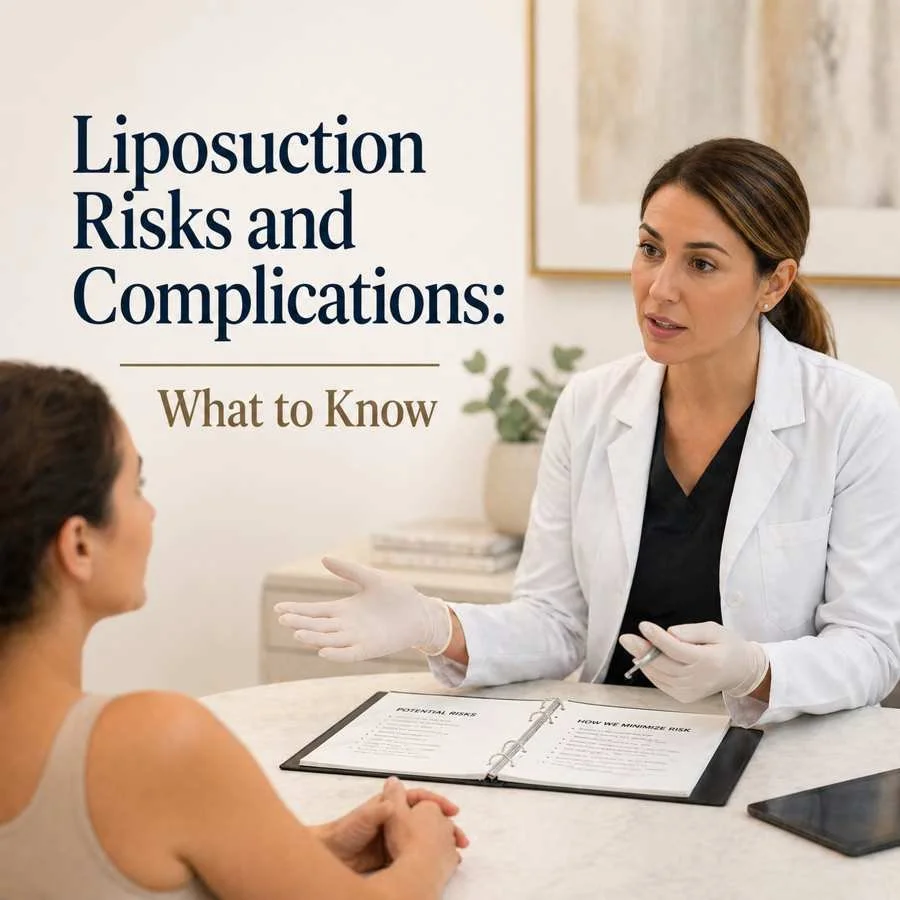
Understanding the Risks and Complications of Liposuction
Updated April 2026
Why an Honest Risk Discussion Makes You a Better Candidate
Every surgical procedure carries risk. Liposuction is one of the most commonly performed cosmetic procedures in the world, with a strong overall safety record when performed by board-certified plastic surgeons in accredited facilities on appropriately selected patients. But "strong safety record" is not the same as "risk-free," and patients who go into liposuction with a clear-eyed understanding of what can go wrong, how likely each complication actually is, and what reduces risk are consistently better prepared, more compliant with post-operative protocols, and more satisfied with their outcomes.
This article covers the full spectrum of liposuction risks and complications honestly, from the expected and temporary to the rare and serious, along with what each one means in practice and what can be done to minimize it. If you are researching liposuction seriously, this is the conversation you should be having before you book a consultation, not after.
Expected Side Effects vs. True Complications
The first distinction worth making is between expected side effects and actual complications. They are not the same thing, and conflating them creates unnecessary anxiety about normal recovery.
Expected side effects are predictable physiological responses to surgery that occur in virtually every patient and resolve on their own with time and proper post-operative care. They include bruising, swelling, temporary numbness, soreness, and fluid drainage from incision sites in the first 48 hours. These are not complications. They are the body's normal response to surgical trauma and they are built into every recovery timeline.
Complications are outcomes that fall outside the expected recovery pattern, require intervention, or represent harm beyond the anticipated healing process. Some are minor and manageable. Some are serious and rare. Understanding the difference between the two allows patients to monitor their recovery intelligently rather than panicking at normal swelling or dismissing something that actually requires attention.
Common and Minor Complications
Seroma
A seroma is a collection of fluid that accumulates in the space left by removed fat. It is the most common true complication of liposuction, occurring in a small percentage of patients. A seroma typically presents as a soft, fluid-filled area in the treated zone that persists beyond the expected swelling timeline. Small seromas often resolve on their own with continued compression garment wear. Larger or persistent seromas are drained by the clinical team using a needle, which is a straightforward office procedure. Proper compression garment wear and avoiding strenuous activity during the early recovery period are the primary preventive measures.
Skin Irregularities and Contour Abnormalities
Uneven skin surface, including areas of lumpiness, waviness, or visible indentation, can occur after liposuction and represents one of the more common aesthetic complications. It results from uneven fat removal, asymmetric swelling resolution, reduced skin elasticity, or insufficient post-operative lymphatic drainage. Mild irregularities often improve significantly over three to six months as swelling fully resolves and the skin retracts. Persistent irregularities may require revision liposuction or treatment with energy-based skin tightening devices.
The risk of contour irregularities is meaningfully reduced by three factors: surgical precision, appropriate patient selection (ensuring the patient's skin elasticity is sufficient to retract cleanly over the new contour), and post-operative lymphatic massage compliance. This is one of the clearest areas where choosing a facility with rigorous standards and structured post-operative protocols directly affects the aesthetic outcome.
Infection
Infection at the incision sites is rare in liposuction performed in accredited surgical facilities under sterile conditions. Signs of infection include increasing redness and warmth around an incision site, purulent discharge, fever, and worsening rather than improving pain beyond the first week. If any of these occur, contact your clinical team immediately. Infections caught early are treated effectively with antibiotics. Delayed treatment allows infection to spread and complicates recovery significantly. Following wound care instructions precisely, keeping incision sites clean and dry, and attending all follow-up appointments are the primary preventive measures within the patient's control.
Prolonged Numbness
Temporary numbness, tingling, or altered sensation in the treated area is normal and expected in the weeks following liposuction. It results from disruption to small sensory nerve fibers during fat removal. For the vast majority of patients, normal sensation returns fully within two to four months as the nerves regenerate. In rare cases, numbness can persist longer. Permanent sensory nerve damage is very uncommon in standard liposuction procedures and is more associated with aggressive or imprecise technique than with the procedure itself.
More Serious Complications
Deep Vein Thrombosis and Pulmonary Embolism
Deep vein thrombosis, or DVT, is the formation of a blood clot in a deep vein, most commonly in the legs. If a clot dislodges and travels to the lungs, it becomes a pulmonary embolism, which is a medical emergency. DVT is a risk associated with any surgical procedure that involves reduced mobility during recovery, not liposuction specifically, but it is serious enough to warrant direct discussion.
The risk factors for post-surgical DVT include extended surgical time, prolonged bed rest during recovery, personal or family history of clotting disorders, smoking, and obesity. The primary preventive measures are early ambulation, meaning getting up and walking within hours of surgery rather than remaining in bed, compression garments, adequate hydration, and in higher-risk patients, pharmacological anticoagulation as prescribed by the surgical team. The Centers for Disease Control identifies surgical patients with limited post-operative mobility as a higher-risk group for DVT and provides guidance on prevention strategies.
Symptoms of DVT include pain, swelling, redness, or warmth in one leg that does not correspond to the treated area. Symptoms of pulmonary embolism include sudden shortness of breath, chest pain, and rapid heart rate. Either requires immediate emergency evaluation.
Fat Embolism
A fat embolism occurs when fat particles enter the bloodstream and obstruct blood vessels, potentially affecting the lungs, brain, or other organs. It is extremely rare in liposuction performed correctly, and it is more associated with trauma than with elective surgical fat removal. The risk is significantly reduced by adherence to safe volume limits, appropriate patient selection, and proper surgical technique. It remains on the risk list because patients deserve to know it exists, not because it is a realistic expectation in a well-selected patient treated at an accredited facility.
Lidocaine Toxicity
The tumescent technique involves injecting a large volume of dilute lidocaine solution into the treatment area before fat removal. Lidocaine is a local anesthetic, and at very high systemic concentrations it can cause toxicity affecting the heart and central nervous system. Lidocaine toxicity in tumescent liposuction is rare when safe dosing limits are respected and the procedure is performed by a qualified team in a monitored setting. The risk increases when volume limits are exceeded or when multiple large areas are treated simultaneously in settings without appropriate monitoring. Accredited surgical facilities with board-certified surgeons adhere to established safe dosing guidelines as a matter of standard practice.
Visceral Perforation
Visceral perforation, meaning accidental penetration of an internal organ by the cannula, is an extremely rare but serious complication. It is almost exclusively associated with abdominal liposuction performed by inadequately trained practitioners, or in non-accredited settings where the standard of care is compromised. Board-certified plastic surgeons performing liposuction in accredited facilities operate with anatomical awareness and technique precision that make this complication vanishingly rare.
Fluid Imbalance
Large-volume liposuction, typically defined as the removal of more than five liters of fat, carries risks related to fluid shifts that do not apply to smaller procedures. The tumescent solution added pre-operatively combined with the fluid lost through fat removal and drainage can create significant fluid balance challenges that require careful intraoperative and post-operative monitoring. Large-volume procedures should only be performed in accredited surgical facilities with appropriate anesthesia and monitoring capabilities, not in office-based settings without those resources.
Technique-Specific Risk Considerations
Different liposuction techniques carry somewhat different risk profiles, and understanding these helps patients evaluate their options accurately.
Standard tumescent liposuction has the longest safety record and the most established risk profile. The risks are well characterized and the technique is performed safely by qualified surgeons worldwide on a daily basis.
VASER ultrasound-assisted liposuction uses ultrasound energy to emulsify fat before removal. The primary technique-specific risk is thermal injury if the ultrasound probe is held stationary rather than kept in continuous motion during use. In experienced hands, this risk is minimal. VASER also carries a slightly higher risk of seroma formation in some studies compared to standard tumescent technique, related to the additional fluid shift caused by the ultrasound energy.
BodyTite and radiofrequency-assisted lipolysis use controlled thermal energy and carry a small risk of skin burns if the temperature monitoring system malfunctions or the device is used incorrectly. Devices used in accredited facilities are maintained and calibrated to manufacturer specifications, reducing this risk significantly.
Laser-assisted lipolysis carries similar thermal injury risks to VASER and requires equivalent care in technique to avoid skin surface burns, particularly in areas where the skin is thin.
Who Is at Higher Risk and Why Patient Selection Matters
Not every patient is an equally good candidate for liposuction, and part of what a rigorous pre-operative evaluation does is identify and address risk factors before they become complications. Patients at higher baseline risk include those who smoke, those with poorly controlled diabetes or hypertension, those with a personal or family history of clotting disorders, those with significantly reduced skin elasticity in the planned treatment areas, and those seeking very large volume fat removal in a single session.
Higher risk does not automatically mean ineligible. It means the evaluation needs to be more thorough, the surgical plan needs to account for the specific risk factors present, and in some cases a staged approach is safer than attempting everything at once. The American Society of Plastic Surgeons maintains clinical guidance on liposuction safety including patient selection criteria and the evidence base for risk reduction strategies.
How the Clinical Setting Affects Risk
The single most important variable in liposuction safety is not the technique used or even the specific risks of the individual patient. It is the standard of the facility and the qualifications of the team performing the procedure.
Liposuction performed in accredited surgical facilities by board-certified plastic surgeons with appropriate anesthesia monitoring has a fundamentally different risk profile from liposuction performed in non-accredited office settings by practitioners without plastic surgery board certification. The serious complications associated with liposuction, including DVT, fat embolism, fluid imbalance, and visceral perforation, are disproportionately concentrated in procedures performed outside accredited settings.
At Adonis Plastic Surgery, every body contouring procedure is performed by board-certified plastic surgeons within a clinical framework that includes pre-operative health screening, appropriate facility standards, structured post-operative monitoring, and accessible follow-up care throughout recovery. The clinical process is built around consistent outcomes and patient safety, not around throughput or convenience.
For patients working through the financial planning side of a procedure, our payment plans and financing options are available to review as part of the overall planning process. Learn more about our approach to liposuction at Adonis Plastic Surgery.
Ready to Have This Conversation in Person?
Understanding the risks of liposuction is the foundation of informed consent. The consultation process at Adonis Plastic Surgery covers every relevant risk factor for your specific anatomy, health history, and planned procedure, and gives you honest answers to every question you bring in.
Adonis Plastic Surgery serves patients throughout the South Bay, including Torrance, Redondo Beach, Palos Verdes, El Segundo, Manhattan Beach, Long Beach, Carson, Gardena, and surrounding communities.