

Breast Reduction
(Reduction Mammaplasty)
Breast reduction removes excess breast tissue, fat, and skin to create a smaller, lighter breast while reshaping the remaining tissue. For many patients, the goal is not only proportion. It is relief from symptoms associated with breast hypertrophy, including neck, shoulder, back, skin, and activity-related concerns.[1]

Breast reduction is about more than breast size.
Large, heavy breasts can affect the neck, shoulders, upper back, skin beneath the breasts, bra fit, exercise, clothing, and everyday comfort. Reduction mammaplasty has been associated with meaningful improvement in physical symptoms and health-related quality of life in published studies.[6] Reduction mammaplasty removes enough tissue to reduce weight while also reshaping the breast and repositioning the nipple and areola when necessary.
The operation is individualized because two patients with the same bra size may have very different breast width, tissue density, skin quality, nipple position, asymmetry, and goals. A safe reduction is planned around anatomy and blood supply rather than a promised cup size.
Adonis performs breast reduction surgery at our Torrance surgical facility for patients throughout Redondo Beach, Palos Verdes, Manhattan Beach, El Segundo, Long Beach, San Pedro, and the greater South Bay and Los Angeles area.
Who tends to benefit most from breast reduction?
Good candidates are generally healthy, have specific concerns related to breast size or weight, understand the scar patterns involved, and have realistic goals for a smaller, more proportionate breast. Smoking, medical conditions, and overall surgical risk are considered during candidacy review.[2]
Physical symptoms
Persistent neck, shoulder, or back discomfort, bra-strap indentations, skin irritation, or difficulty staying physically active may make reduction particularly meaningful.
Disproportionately large breasts
You feel your breast volume is out of proportion with your frame or makes clothing, exercise, or everyday movement unnecessarily difficult.
Realistic size goals
Your surgeon can discuss the amount of tissue that can be removed safely, but an exact postoperative cup size cannot be guaranteed because bra sizing is not standardized.
Can insurance cover breast reduction surgery?
Possibly. Breast reduction may qualify for insurance coverage when a health plan determines that the procedure meets its medical-necessity requirements. Coverage is based on the patient’s specific policy, documentation requirements, network rules, and authorization criteria, so approval cannot be promised in advance.[7]
What insurance may look for.
Requirements differ from one plan to another. Depending on the policy, an insurer may ask for documentation of persistent symptoms, prior treatment, photographs, clinical findings, or an estimate of the amount of tissue expected to be removed. The insurer’s own policy controls the final decision.
- Documented neck, back, or shoulder symptoms
- Bra-strap grooving or recurrent skin irritation
- Difficulty with physical activity or daily function
- Clinical records, photographs, or prior treatment history
- An estimate of the amount of breast tissue expected to be removed
We can help you figure out the next step.
If insurance coverage is important to your decision, start by contacting Adonis before assuming that your procedure is or is not covered. Our team can review the basic insurance information you provide, help you understand what needs to be checked, and explain the next step for your specific situation.
You should be ready to provide your insurance carrier and plan information. If additional documents or images of your insurance card are needed, our team will tell you the appropriate way to provide them.
Reducing weight while preserving shape, proportion, and blood supply.
Reduction mammaplasty combines tissue removal with breast reshaping. The amount removed matters, but so do the final breast footprint, nipple position, symmetry, lower-pole shape, and the blood supply to the nipple-areola complex.
Vertical / lollipop reduction
An incision around the areola with a vertical line to the breast crease may be appropriate for selected reductions where skin excess can be managed without a longer horizontal scar.
Anchor / inverted-T reduction
For larger or more ptotic breasts, an incision around the areola, vertically downward, and along the breast fold allows broader tissue and skin removal and more extensive reshaping.
Nipple and areola position
The nipple-areola complex is typically repositioned to fit the smaller breast. An enlarged areola may also be reduced when appropriate.
How breast reduction surgery is performed.
Breast reduction may be performed under general anesthesia or another anesthesia plan selected by the surgical team, depending on the patient and procedure.[3] After the planned incisions are made, the surgeon removes selected breast tissue, fat, and excess skin, reshapes the remaining breast, and repositions the nipple and areola when necessary.
The exact technique depends on breast size, tissue distribution, skin excess, asymmetry, nipple position, planned reduction volume, and the blood supply required to keep the nipple-areola complex healthy.
Consultation and measurements
Your surgeon evaluates breast volume, ptosis, breast width, nipple position, skin quality, asymmetry, symptoms, health history, and the size change you hope to achieve.
Tissue and skin reduction
Excess glandular tissue, fat, and skin are removed according to the surgical plan while preserving appropriate blood supply and breast structure.
Breast reshaping and nipple repositioning
The remaining tissue is shaped into a smaller breast mound, and the nipple and areola are repositioned when needed for the new breast proportions.
Closure and support
Incisions are closed in layers, dressings and a support bra are applied as indicated, and you leave with detailed aftercare instructions and scheduled follow-up.
Considering breast reduction because of discomfort, proportion, or both? Your surgeon can help determine how much reduction is safe and what breast shape is realistic for your anatomy.
REQUEST MY CONSULTATIONBreast reduction before and after.
A strong breast-reduction result is not simply a smaller breast. Look at proportion, symmetry, nipple position, breast contour, lower-pole shape, and whether the final breast fits the patient's torso without looking flattened or over-reduced.
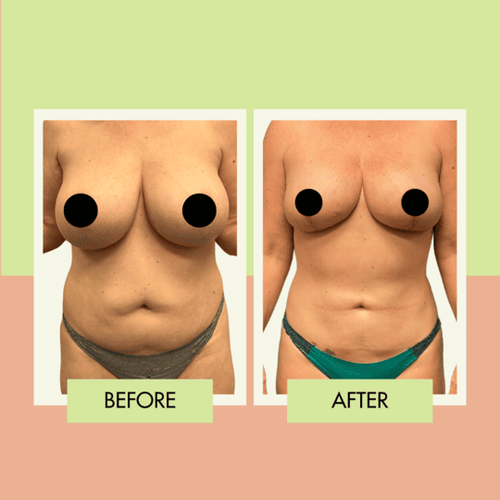
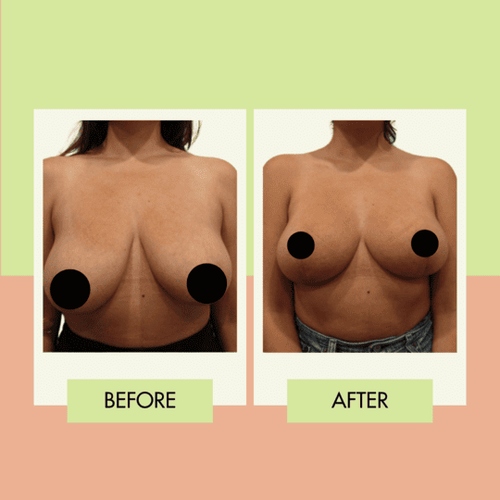
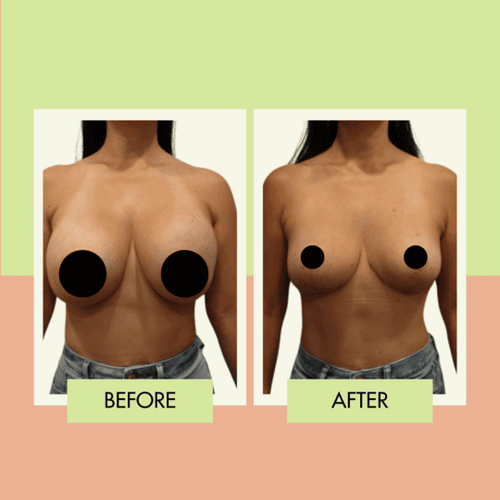
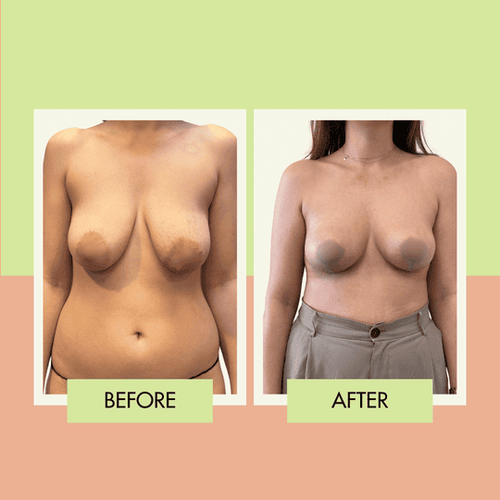
Individual results vary. Photos are shared with patient consent. Starting breast size, reduction volume, skin quality, incision pattern, asymmetry, healing, and scar maturation affect the final result.
For a deeper way to evaluate surgical galleries, read our guide to comparing breast reduction results.
Both reshape the breast, but they answer different goals.
A breast lift primarily raises and reshapes the breast by removing excess skin. Breast reduction removes a more meaningful amount of breast tissue and weight in addition to lifting and reshaping.
If the main concern is sagging and you want to preserve approximately your current breast volume, a lift may be enough. If the breasts feel too large, heavy, or physically limiting, reduction mammaplasty may be the more appropriate operation.
Insurance considerations can also differ because a breast reduction may sometimes be evaluated as medically necessary, while a cosmetic lift is generally approached differently by health plans.
Expect early relief in weight, but give the incisions time to heal.
The breasts are swollen immediately after surgery, so the final size and shape cannot be judged during the first few weeks. Dressings or a support bra may be used, and activity restrictions remain important while the incisions heal.[4] Soreness, bruising, tightness, temporary numbness, and changes in nipple sensation may occur as the tissues heal.
Rest and short walks
Swelling and soreness are expected. Incision care, a prescribed support garment, medication instructions, hydration, and gentle walking are the priorities.
Light work often resumes
Many patients return to sedentary work during this period, depending on comfort and incision healing. Lifting and strenuous upper-body activity remain restricted.
Activity expands gradually
Exercise returns in stages only after surgeon clearance. Incision tension, swelling, and any areas of delayed healing affect the timeline.
Shape and scars mature
The breast softens and settles as swelling resolves. Scar color and firmness continue changing for many months after daily activity feels normal.
For exercise planning after surgery, read our breast reduction exercise and recovery guide.
Reduction changes the breast permanently, but life can change it again.
The tissue removed during reduction does not return, but remaining breast tissue and skin can change with aging, pregnancy, hormonal changes, and substantial weight fluctuation. Maintaining a stable weight helps preserve the result.
Breastfeeding
Some patients can breastfeed after breast reduction, but lactation cannot be guaranteed. Reduction technique, existing anatomy, the amount of tissue removed, and individual milk production all affect the possibility.
Pregnancy after reduction
Pregnancy is possible after surgery, but breast enlargement and later volume loss can stretch the remaining skin and alter breast size or position again.
Mammograms and screening
Routine breast imaging can continue after reduction. Tell the imaging facility that you have had breast surgery and follow screening recommendations from your health care provider.
Breast reduction with consultation, surgery, and follow-up connected to one plan.
Adonis Plastic Surgery is a QUAD A-accredited outpatient surgical facility at 2557 Pacific Coast Highway, Torrance, CA 90505. Consultation, operative planning, surgery-day care, and postoperative follow-up are coordinated through the Torrance practice.
We serve patients throughout Torrance, Redondo Beach, Palos Verdes, Rolling Hills Estates, Lomita, Harbor City, San Pedro, Gardena, Carson, Manhattan Beach, El Segundo, Long Beach, and the greater South Bay. Practical planning includes time away from work, lifting restrictions, incision care, support garments, exercise, driving, help at home, and insurance documentation when applicable.
Breast reduction cost in Torrance and Los Angeles.
Self-pay pricing depends on breast size, the amount of tissue and skin removal, incision pattern, surgical complexity, asymmetry, anesthesia, and facility requirements. Insurance-approved cases may follow a different financial process depending on the patient's benefits and authorization.
Self-Pay Breast Reduction at Adonis
$13,000 – $20,000This is the updated Adonis self-pay range for reduction mammaplasty. Your final itemized quote is based on the surgeon's recommended technique, operative complexity, anesthesia, facility requirements, and individual plan.
Insurance or financing
If you are exploring insurance, start with the insurance section above so our team can help you understand the next step. For self-pay cases, qualified patients may also use available financing options.
CHECK INSURANCE OPTIONS VIEW PAYMENT PLANSInsurance approval does not necessarily mean the procedure has no out-of-pocket cost. Deductibles, copayments, coinsurance, network status, authorization conditions, and other plan terms may affect patient responsibility.
Common questions about reduction mammaplasty and insurance.
Does insurance cover breast reduction surgery?
It can. Some health plans cover breast reduction when their medical-necessity requirements are met and the required authorization is approved. Coverage varies by insurer and policy, so Adonis cannot guarantee approval until the applicable plan requirements are reviewed.
Which surgeons perform breast reduction at Adonis?
Breast reduction at Adonis is performed by board-certified plastic surgeons Dr. Shana S. Kalaria and Dr. Joshua Y. Jacobson. Dr. Kalaria medically reviewed this page.
How do I find out if my insurance may cover breast reduction?
Start by contacting Adonis and letting us know insurance coverage is important to you. Be ready to provide your insurance carrier and plan information. Our team can help you understand what needs to be checked and what information may be required for the next step. You can text (310) 402-2314 and send: “Does insurance cover my breast reduction procedure at Adonis?”
What can make a breast reduction medically necessary?
Health plans may consider symptoms such as persistent neck, back, or shoulder discomfort, bra-strap grooving, skin irritation beneath the breasts, or limits on physical activity. The specific definition of medical necessity and the required documentation vary by plan.
What documents can insurance require for breast reduction?
Depending on the plan, requirements may include clinical notes documenting symptoms, photographs, prior treatment history, physician documentation, and an estimate of how much breast tissue the surgeon expects to remove. Not every insurer asks for the same information.
Is insurance approval guaranteed if I have back or shoulder pain?
No. Symptoms can be relevant, but the insurer applies its own medical-necessity, benefit, network, and authorization rules. Neither symptoms nor a surgeon's recommendation alone guarantee coverage.
What happens if my insurance does not cover breast reduction?
You can still discuss a self-pay surgical plan with Adonis. The current self-pay range is $13,000 to $20,000 depending on surgical complexity and the individualized plan, and financing may be available for qualified patients.
What is breast reduction surgery?
Breast reduction, or reduction mammaplasty, removes excess breast tissue, fat, and skin to reduce breast size and weight. The remaining tissue is reshaped, and the nipple and areola are commonly repositioned to suit the smaller breast.
What is the difference between breast reduction and breast lift?
Both operations reshape and lift the breast, but breast reduction removes a more substantial amount of breast tissue and weight. A breast lift primarily addresses sagging and position while preserving more of the patient's existing breast volume.
How much smaller can I go with breast reduction?
The safe amount of reduction depends on starting breast size, breast width, tissue quality, blood supply to the nipple and areola, and the shape you want. A surgeon can estimate the likely reduction, but an exact postoperative bra cup size cannot be guaranteed.
How long does breast reduction surgery take?
Breast reduction commonly takes approximately two to four hours. Operative time varies with breast size, reduction volume, incision pattern, asymmetry, and surgical complexity.
What scars does breast reduction leave?
Scars are permanent. Many reductions use either a lollipop pattern around the areola and vertically to the breast crease or an anchor pattern that also extends horizontally along the fold. Scar color and firmness typically change substantially during the first year.
How long is breast reduction recovery?
Many patients return to desk-based work within one to two weeks. Strenuous exercise and heavier lifting are restricted longer, and final breast shape and scar maturation continue for several months.
When can I exercise after breast reduction?
Walking usually begins early. More strenuous exercise and upper-body activity return gradually after your surgeon confirms that the incisions and deeper tissues are ready. Many patients build back toward broader exercise over four to six weeks, but the actual timeline is individualized.
Will breast reduction help neck, shoulder, or back discomfort?
Many patients pursue reduction specifically because large, heavy breasts are associated with neck, shoulder, or back symptoms and limits on activity. Whether surgery will relieve a particular symptom depends on its cause and cannot be guaranteed for every patient.
Can breast reduction help rashes under the breasts?
Reducing breast size and the amount of skin-on-skin contact may improve friction and moisture beneath the breast fold in appropriate patients. Persistent rashes should also be medically evaluated because they can have causes unrelated to breast size.
Can I breastfeed after breast reduction?
Some patients are able to breastfeed after reduction, but future breastfeeding cannot be guaranteed. The technique, anatomy, amount of tissue removed, and individual milk-production capacity all matter.
Can I have breast reduction before pregnancy?
Yes, but pregnancy can enlarge the breasts and later change their volume and skin again. If pregnancy is planned soon, discuss timing with your surgeon because it may alter the durability of your surgical result.
Can breast reduction be part of a mommy makeover?
Yes. Breast reduction may be combined with tummy tuck, liposuction, or other selected procedures as part of a mommy makeover when the surgeon determines the total operative plan is appropriate.
What are the risks of breast reduction surgery?
Potential risks include bleeding, infection, poor wound healing, fluid collection, asymmetry, contour irregularity, changes in breast or nipple sensation, unfavorable scarring, fat necrosis, partial or total nipple-areola loss, difficulty breastfeeding, anesthesia complications, blood clots, and the possibility of revision surgery.[5]
How much does breast reduction cost in Torrance or Los Angeles?
The updated Adonis self-pay range is $13,000 to $20,000. Final pricing depends on breast size, reduction volume, technique, complexity, anesthesia, facility requirements, and the individualized surgical plan. Insurance-approved cases may have a different patient responsibility based on the health plan.
Do you see breast reduction patients from outside Torrance?
Yes. Adonis Plastic Surgery is in Torrance and serves patients from Redondo Beach, Palos Verdes, Manhattan Beach, El Segundo, Long Beach, San Pedro, Gardena, Carson, Lomita, and throughout the South Bay and Greater Los Angeles.
Clinical information reviewed against independent medical sources.
This page was medically reviewed by Shana S. Kalaria, MD, MBA, an American Board of Plastic Surgery-certified plastic surgeon, on September 13, 2026. These references support general educational information about candidacy, technique, recovery, risks, symptom improvement, and insurance-related medical-necessity concepts. They do not replace individualized medical advice or the terms of a patient’s health plan.
American Society of Plastic Surgeons
American Society of Plastic Surgeons
American Society of Plastic Surgeons
American Society of Plastic Surgeons
American Society of Plastic Surgeons
Systematic review & meta-analysis · PubMed
American Society of Plastic Surgeons
Systematic review & meta-analysis · PubMed
Joshua Y. Jacobson, MD · ASPS profile
Find out what a safe, proportional reduction could look like for you.
Meet with one of our board-certified plastic surgeons to review breast size, symptoms, skin and tissue quality, nipple position, reduction goals, scars, recovery, and whether insurance may be relevant to your case. You will receive a clear surgical recommendation and detailed next steps before deciding whether to move forward.