

Labiaplasty Surgery
(Labia Reduction)
Labiaplasty reshapes or reduces labial tissue when anatomy causes persistent pulling, irritation, asymmetry, or a personal concern that remains meaningful after counseling. There is no single “normal” labial appearance, and the goal should be a measured change that respects function, sensation, and individual anatomy.[1]

Why patients consider labiaplasty.
There is no single correct labial shape, size, or level of symmetry. Published anatomical reviews show wide natural variation in length, width, visibility, and side-to-side symmetry. Surgery is a personal choice, not a requirement, and counseling should distinguish normal variation from a functional problem or a persistent personal concern.[2]
Physical discomfort
Excess tissue may twist, pull, pinch, or chafe during exercise, cycling, intimacy, sitting, or while wearing fitted clothing.
Asymmetry or tissue changes
Genetics, hormonal changes, aging, pregnancy, or childbirth may leave one side longer, alter the tissue, or create changes that feel uncomfortable.
A personal aesthetic concern
Some patients feel self-conscious about visible tissue or imbalance. Your surgeon will discuss what is realistically achievable without pushing you toward surgery.
There is a wide range of normal.
Labia naturally vary in size, shape, color, texture, visibility, and symmetry. One side may be longer than the other, and visible inner labia are common. None of these features automatically means something is abnormal.[2]
Labiaplasty should not be presented as a way to create one “ideal” appearance. The right question is whether your anatomy causes a concern that matters to you and whether surgery can address it safely without removing too much tissue.
A responsible consultation may end with a surgical plan, a recommendation to wait, or reassurance that no treatment is needed.
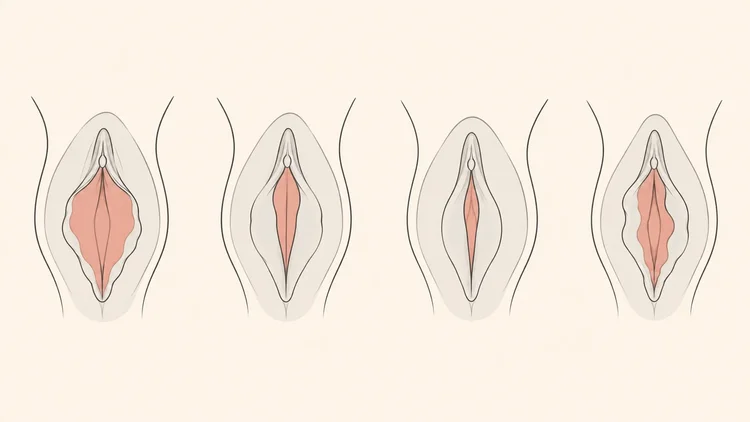
The operation is designed around your anatomy.
Labiaplasty is not one standardized operation. Your surgeon evaluates which tissue is creating the concern, how the area functions, and how much change can be made while preserving a natural contour.
Labia minora reduction
Reduces or reshapes the inner labial tissue when length, asymmetry, pulling, or irritation is the primary concern.
Labia majora contouring
Addresses excess or uneven outer labial tissue when appropriate. This is a separate consideration and is not automatically part of every labiaplasty.
Clitoral hood reduction
Reduces redundant hood tissue only when it contributes to imbalance and when the surgeon determines it can be treated safely. It should never be added routinely.
What happens during labiaplasty.
Labiaplasty is commonly performed as an outpatient procedure. Depending on the operation and patient needs, anesthesia may range from local anesthesia with sedation to general anesthesia.[3]
The planned reduction is marked carefully, the selected tissue is reshaped or removed, bleeding is controlled, and closure is commonly performed with absorbable sutures. The exact method depends on anatomy and technique.[3]
Private consultation
Your surgeon listens to the physical and aesthetic concerns, examines the anatomy, explains normal variation, and determines whether surgery is appropriate.
Customized planning
The treatment area, amount of tissue removal, incision pattern, anesthesia, recovery, risks, and full price are reviewed before you decide.
Reshaping and closure
The surgeon performs the selected technique with attention to symmetry, natural edges, blood supply, and avoiding excessive tissue removal.
Same-day discharge
You leave with written aftercare instructions, prescribed medication when needed, and scheduled follow-up visits to monitor healing.
Trim and wedge are different tools, not competing packages.
The correct technique depends on tissue thickness, edge characteristics, asymmetry, blood supply, and the result being planned. Systematic reviews do not establish one universally superior method; technique-specific trade-offs and complication patterns differ, so the operation should be selected for the individual patient.[4]
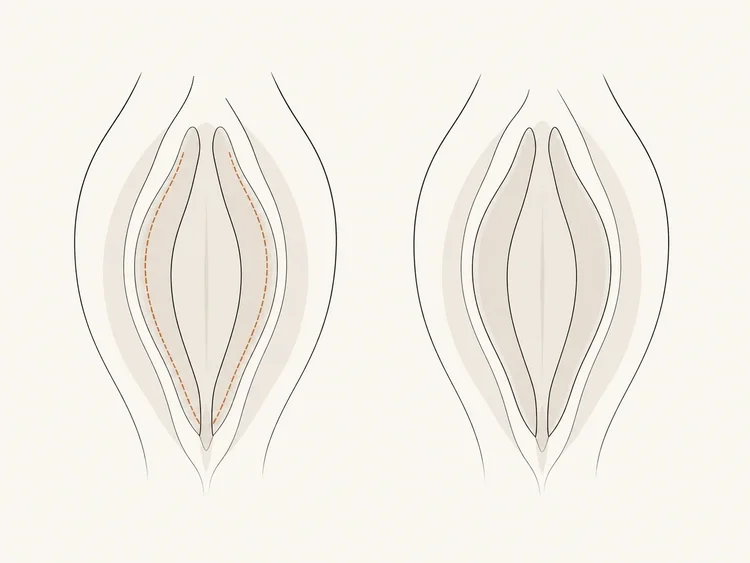
Trim technique
Removes tissue along the outer edge. It may be useful when the edge itself is the primary concern or when a direct reduction provides the most controlled contour.
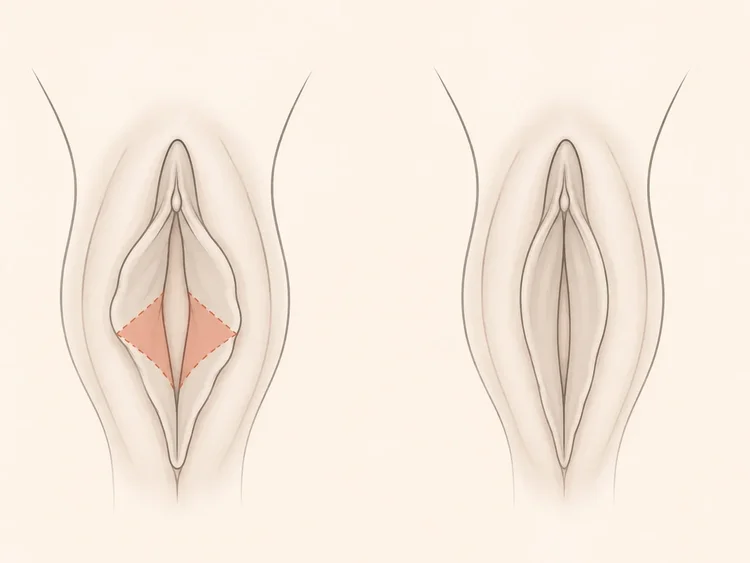
Wedge technique
Removes a wedge-shaped section while retaining more of the natural outer edge. It may be suitable for certain tissue patterns but also has its own healing considerations.
The illustrations are educational only. They do not represent a promise of a specific result or replace an in-person surgical evaluation.
You do not need to know which technique you need before coming in. That is what the consultation is for.

A sensitive procedure should feel handled that way.
This is not a concern you should have to explain repeatedly or discuss in a crowded setting. Our goal is to make every stage clear, discreet, and clinically respectful.
We will be direct about what surgery cannot guarantee.
Labiaplasty creates incisions in delicate tissue. Potential complications include bleeding, hematoma, infection, wound separation, scarring, persistent pain, altered sensation, dyspareunia, asymmetry, dissatisfaction, and the possibility of revision.[5]
Removing too much tissue can create functional problems that are difficult to correct. A careful operation is not about making the area as small as possible. It is about making a measured change while respecting blood supply, sensation, tissue coverage, and natural anatomy.
High-quality comparative evidence remains limited. The consultation should include normal variation, alternatives, expected benefits, uncertainty, technique-specific risks, and the possibility that no surgery is the right recommendation.
What to expect after surgery.
The first week usually requires the most planning. Swelling, bruising, and sensitivity are expected early, and the final appearance should not be judged during initial healing. Many patients take about a week away from work, while sexual activity, tampons, cycling, swimming, and strenuous exercise are commonly restricted for roughly four to six weeks or until the surgeon confirms adequate healing.[3]
Swelling and rest
Plan to rest, limit pressure and friction, use cold therapy only as directed, and keep the area clean and dry according to your instructions.
Return to light work
Many patients can resume desk-based work within about a week, depending on comfort, swelling, and the demands of the job.
Steady improvement
Swelling and sensitivity continue to settle. Strenuous exercise, cycling, friction, and pressure on the area remain restricted.
Gradual full activity
Sexual activity, tampons, baths, swimming, and higher-impact exercise resume only after your surgeon confirms adequate healing.
Private labiaplasty care with consultation, surgery, and follow-up connected to one practice.
Adonis Plastic Surgery is a QUAD A-accredited outpatient surgical facility at 2557 Pacific Coast Highway, Torrance, CA 90505. Consultation, surgical planning, procedure-day care, and postoperative follow-up are coordinated through the Torrance practice.
We serve patients throughout Torrance, Redondo Beach, Palos Verdes, Rolling Hills Estates, Lomita, Harbor City, San Pedro, Gardena, Carson, Manhattan Beach, El Segundo, Long Beach, and the greater South Bay. For a sensitive procedure, practical planning includes privacy, transportation, time away from work, hygiene, clothing, exercise restrictions, sexual activity, and access to the surgical team during healing.
Pricing and financing.
Pricing depends on the area being treated, the surgical technique, anesthesia, and whether another procedure is performed at the same time. You receive an itemized quote before making a commitment.
Labiaplasty in the South Bay
$3,000 – $8,000Estimated range based on the current Adonis pricing guide. Your final quote may include the surgeon fee, anesthesia, facility, and follow-up care according to your specific treatment plan.
Monthly payment options
Financing may be available through Cherry, CareCredit, Affirm, Klarna, and AfterPay, subject to approval and the terms of the selected provider.
VIEW PAYMENT PLANSCommon questions.
What exactly does labiaplasty change?
Most commonly, labiaplasty reduces or reshapes the labia minora, the inner folds of tissue. Depending on the concern, the plan may also evaluate the labia majora or clitoral hood. These are separate anatomical areas, and not every patient needs treatment beyond the labia minora.
Who performs labiaplasty at Adonis?
Labiaplasty at Adonis is performed by board-certified plastic surgeons Dr. Shana S. Kalaria and Dr. Joshua Y. Jacobson. Dr. Kalaria medically reviewed this page.
How do I know whether my anatomy is normal?
Labia vary widely in length, shape, color, texture, and symmetry. Visible inner labia and differences between the two sides are common. A consultation can determine whether a symptom has another cause and whether surgery is appropriate, but appearance alone does not mean something is abnormal.
Will labiaplasty affect sensation?
The surgical plan is designed to protect important tissue and avoid unnecessary removal, but no surgery can guarantee unchanged sensation. Available studies suggest many patients report stable or improved sexual-function measures after labiaplasty, but the evidence is largely observational and certainty is limited.[6] Temporary or persistent sensory change remains a recognized risk.
How painful is recovery?
Most patients experience swelling, tenderness, and mild to moderate discomfort during the first several days. Medication, rest, limiting friction, and following hygiene instructions make recovery more manageable. Pain that is severe, worsening, or accompanied by other concerning symptoms should be reported promptly.
When can I exercise or have sex after labiaplasty?
Walking and light daily activity usually return first. Higher-impact exercise, cycling, sexual activity, tampons, baths, and swimming are commonly restricted for approximately four to six weeks or longer. Resume them only when your surgeon confirms that healing is adequate.
Will there be visible scars?
Incisions are placed within the treated labial tissue and generally become less noticeable as healing progresses. Scar appearance varies, and swelling can temporarily make the area look uneven. Your surgeon will explain the planned incision pattern and realistic healing expectations.
Is labiaplasty the same as vaginoplasty?
No. Labiaplasty reshapes external labial tissue. Vaginoplasty addresses the vaginal canal and supporting tissues. They are different operations intended for different concerns.
Is labiaplasty covered by insurance?
It is usually considered cosmetic and is commonly not covered. Coverage may occasionally be considered when documented symptoms meet an insurer’s medical-necessity requirements. You should confirm directly with your insurance provider before relying on coverage.
Can labiaplasty be performed before pregnancy?
It can be, but pregnancy and childbirth may change the tissue later. Patients who expect to become pregnant should discuss timing, future goals, and the possibility of additional changes with their surgeon.
How old do you have to be for labiaplasty?
Elective cosmetic labiaplasty is generally considered only after physical maturity. Surgery in patients younger than 18 requires special caution and is typically limited to significant congenital differences or persistent functional symptoms after careful medical evaluation.
Clinical information reviewed against independent guidance and published evidence.
This page was medically reviewed by Shana S. Kalaria, MD, MBA, an American Board of Plastic Surgery-certified plastic surgeon, on September 13, 2026. Labiaplasty evidence includes observational studies, systematic reviews, and professional guidance, but high-quality controlled data remain limited. These sources support patient education about normal variation, technique, recovery, risks, and informed consent; they do not replace individualized medical advice.
Counseling, normal variation, evidence limitations and complications
Review of normative datasets for female genital anatomy · PubMed
Procedure, anesthesia, technique, recovery and risks
2024 systematic review & meta-analysis · PubMed
Systematic review & meta-analysis of technique and complications · PubMed
2026 systematic review & meta-analysis; evidence-quality limitations noted · PubMed
Review of ≥1-year outcomes · PubMed
2026 evidence on anatomical variability · PubMed
You can ask the questions you have not felt comfortable asking elsewhere.
There is no pressure to know the medical terms or arrive ready for surgery. Tell us what is bothering you. One of our board-certified plastic surgeons can explain what falls within normal variation, what can realistically be changed, what the trade-offs are, and whether surgery makes sense for you.