

Lower Eyelid Surgery in Torrance
Under-Eye Bag Surgery
Lower eyelid surgery treats persistent under-eye bags, bulging orbital fat, selected loose skin, and an uneven lid-to-cheek transition that can make the eyes look tired even when you feel rested. Modern lower blepharoplasty emphasizes anatomy-based planning and tissue preservation rather than simply removing as much fat or skin as possible.[1]

What lower blepharoplasty actually treats.
True lower-eyelid bags are often created when the fat that normally cushions the eye becomes more prominent through the lower eyelid.[2] That bulge can sit directly above a tear-trough hollow, creating a peak-and-valley contour that casts a persistent shadow beneath the eye.
Lower blepharoplasty can remove or reposition selected fat, address appropriate skin excess, and smooth the transition between the lower eyelid and upper cheek. The treatment is customized because a patient with isolated hereditary fat bags may need a very different operation from a patient with skin laxity and weaker lower-lid support.
Adonis performs lower eyelid surgery at our Torrance surgical facility for patients throughout Redondo Beach, Palos Verdes, Manhattan Beach, El Segundo, Long Beach, San Pedro, Gardena, Carson, and the greater South Bay and Los Angeles area.
Not every swollen under-eye needs surgery.
Lower blepharoplasty is designed for structural anatomy. Puffiness that changes substantially from morning to evening, fluctuates with allergies, salt intake, sinus symptoms, sleep, or another medical condition may have a different cause and should not automatically be treated as a surgical fat-bag problem.
By contrast, hereditary or age-related orbital fat prominence tends to remain present even when you are well rested. A younger patient can have significant bags because of genetics, while an older patient may have a combination of fat prominence, skin laxity, tear-trough hollowing, and lower-lid looseness.
The consultation should identify what is actually creating the bag before deciding whether to remove fat, reposition it, treat skin, support the lid, or recommend something other than surgery.
Who tends to benefit most from lower eyelid surgery?
Age is not the deciding factor. The more important questions are whether the under-eye concern is structural, whether the lower lid has enough tone and support, how much skin laxity is present, whether dry-eye or other ocular conditions matter, and what change you are hoping to achieve.
Persistent genetic eye bags
You have had visible lower-lid bags for years, sometimes since your 20s or 30s, and they remain despite adequate sleep, skin care, and a healthy routine.
Age-related under-eye changes
Fat prominence, skin laxity, tear-trough shadowing, and a more visible lid-cheek junction have developed gradually with aging.
Healthy lower lids and realistic goals
Your surgeon evaluates lower-lid tone, eye health, previous surgery or filler, dry-eye symptoms, smoking, medications, and healing risks before recommending treatment.
The incision depends on what needs to be corrected.
There is no single lower-blepharoplasty technique that is best for every patient. Contemporary reviews emphasize matching transconjunctival, transcutaneous, or combined approaches to anatomy and the specific tissues that require correction.[1] The surgeon chooses the approach according to the fat pads, skin excess, lid support, tear trough, previous procedures, and how much access is needed to correct the actual problem.
Transconjunctival lower blepharoplasty
The incision is placed on the inner surface of the lower eyelid, so there is no external lower-lid incision. It is particularly useful when fat prominence is the main concern and significant skin removal is not required.
- No external skin scar from the fat-access incision
- Direct access to lower-eyelid fat compartments
- Fat may be conservatively removed or repositioned
- Often well suited to younger patients with good skin elasticity
Transcutaneous lower blepharoplasty
A fine external incision is placed just below the lashes when the surgeon needs to address skin and other lower-lid structures directly. The operation may incorporate conservative skin removal and, when needed, lower-lid support.
- Allows direct treatment of meaningful skin excess
- Can address multiple lower-lid components in one approach
- Requires careful assessment of lid tone and position
- The incision is designed close to the lash line for concealment
Smoother often matters more than emptier.
Older lower-blepharoplasty techniques often focused heavily on removing prominent fat. In the right patient, fat removal remains useful. But removing too much can create a hollow or skeletonized under-eye, especially when the patient already has a visible tear trough.
Fat repositioning moves selected orbital fat toward the hollow along the orbital rim to soften the transition from the lower eyelid into the cheek.[3] The goal is not to keep every bit of fat or remove every bit of fat. It is to create the smoothest contour appropriate for the patient's anatomy.
Dark circles are not one problem.
A dark under-eye can come from shadowing created by a fat bag and tear-trough hollow, visible blood vessels through thin skin, true skin pigmentation, volume loss, or several of these at the same time.
Lower blepharoplasty can improve dark circles when the darkness is primarily a shadow created by contour. It does not erase melanin-based pigmentation simply because the fat bag has been corrected. Skin texture and pigment may require a separate treatment plan.
A patient should know before surgery whether the concern being treated is the bag, the hollow, the skin, the pigment, or a combination. Calling all of those “dark circles” leads to unrealistic expectations.
The lower eyelid has to stay supported against the eye.
Lower blepharoplasty is not only about removing bags. The surgeon also evaluates the strength, position, and elasticity of the lower eyelid because a loose or poorly supported lid has a greater risk of being pulled downward after surgery.
Lid tone matters
The lower lid should maintain appropriate contact with the eye. Preoperative examination helps identify laxity before tissue is removed or repositioned because lower-lid support and malposition risk materially affect technique selection.[4]
Canthopexy or canthoplasty
Selected patients with lower-lid laxity may need additional lateral support. Whether reinforcement is appropriate depends on anatomy, existing lid position, and the planned approach.
Conservative skin removal
Removing too much lower-lid skin can create tension and contribute to lid malposition. Skin treatment should be measured rather than aggressive.
How lower eyelid surgery is planned and performed.
The surgeon evaluates the lower eyelid at rest and in motion, including fat prominence, tear-trough depth, skin quality, lid position, lid laxity, cheek support, asymmetry, dry-eye symptoms, and previous under-eye procedures or filler.
The operation may be performed through a transconjunctival or external approach. Fat is removed or repositioned according to the contour, skin is treated only when needed, and lower-lid support is added when the anatomy calls for it. The anesthesia plan depends on the procedure and patient.
Under-eye and lid-support evaluation
Your surgeon assesses fat pads, tear troughs, lower-lid tone, skin, cheek volume, eye health, dry-eye symptoms, asymmetry, previous filler or surgery, and the result you want.
Choose the appropriate access
Transconjunctival access may be selected for primarily fatty bags, while an external approach may be used when meaningful skin treatment or additional structural work is needed.
Contour the fat and lid-cheek junction
Fat is conservatively removed, repositioned, or both, with the goal of flattening the bag without creating an unnaturally hollow under-eye.
Skin, support, and recovery
Selected skin treatment or lid support is completed when appropriate. You leave with detailed eye care, swelling, activity, and follow-up instructions.
If your under-eye bags are always there, even after a good night's sleep, the important question is whether the problem is fat, a tear-trough hollow, loose skin, lower-lid laxity, or a combination.
REQUEST MY CONSULTATIONLower blepharoplasty before and after.
The best lower-eyelid result should not look as if the under-eye was simply emptied. Look at the reduction in bag projection, the transition into the cheek, preservation of normal eye shape, lower-lid position, symmetry, and whether the patient looks rested rather than hollow.
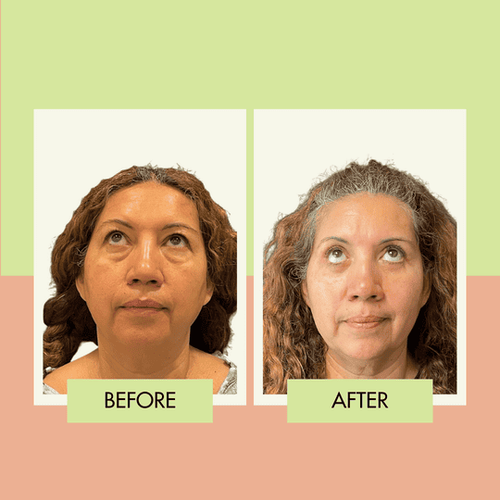
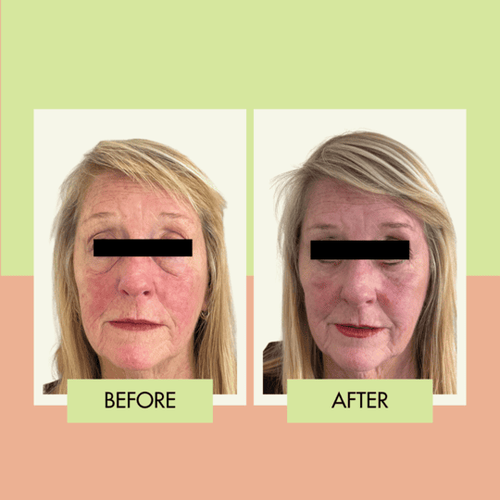
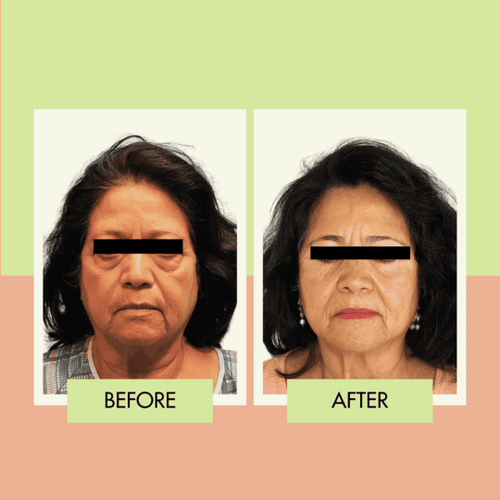
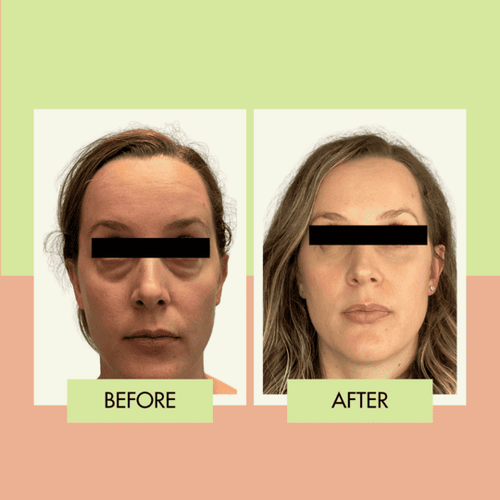
Individual results vary. Photos are shared with patient consent. Fat prominence, tear-trough anatomy, skin laxity, lid support, cheek structure, technique, swelling, and healing all influence the final result.

A visible change without changing the character of the eyes.
Lower blepharoplasty can create a meaningful difference because the bag-and-hollow pattern occupies such a central part of the face. The strongest results do not make the lower eyelid look operated on. They remove the persistent tired-looking contour while keeping the eyes familiar and expressive.
Filler, resurfacing, and lower blepharoplasty do not solve the same problem.
Patients often arrive asking whether a less invasive treatment can replace surgery. Sometimes it can address a different part of the under-eye concern. The key is matching the treatment to the anatomy instead of choosing based only on downtime.
Lower blepharoplasty
Directly treats prominent lower-eyelid fat bags and can address appropriate skin excess, tear-trough contour, and lower-lid support when needed.
Under-eye filler or volume restoration
May camouflage selected hollows by adding volume but does not remove a true protruding fat bag. Previous filler can also affect under-eye assessment and should be disclosed.
Laser or skin resurfacing
May improve fine lines, texture, and selected skin laxity but does not remove the structural orbital fat responsible for a true eye bag.
Lower blepharoplasty has a different job from upper and double-eyelid surgery.
These procedures treat different anatomy. Lower blepharoplasty addresses the under-eye and lower-lid region, while upper blepharoplasty and double-eyelid surgery address different structures and concerns.
Lower blepharoplasty
Treats under-eye bags, lower-lid fat, selected lower-lid skin, tear-trough contour, and the lid-cheek transition.
Upper blepharoplasty
Treats hooded or redundant upper-eyelid skin and selected upper-lid fullness. Explore upper eyelid surgery.
Double eyelid surgery
Creates or defines an upper-eyelid crease and is a different surgical goal from removing lower-eye bags. Explore Asian blepharoplasty.
For a full comparison of the three categories, read our guide to choosing the right eyelid surgery.
Most patients feel better before all of the swelling disappears.
Swelling and bruising around the lower eyelids are expected. Lower-lid swelling can persist somewhat longer than upper-lid swelling, particularly when skin treatment or more extensive contour work is performed. Most patients become socially comfortable well before the tissues have completely settled.
Swelling and bruising peak
Head elevation, cold compresses, prescribed eye care, rest, and avoiding bending, straining, and strenuous activity are commonly emphasized.
Appearance improves steadily
Bruising and swelling begin clearing. External sutures, when used, are managed according to the surgeon's follow-up schedule.
Many patients return socially
Most patients can return to routine work or social settings within roughly this window, although makeup, residual swelling, and individual healing affect readiness.
The lid-cheek contour refines
Residual swelling continues resolving and the under-eye softens. Incisions and subtle asymmetries keep improving long after normal activities resume.
For a broader recovery comparison across eyelid procedures, read our eyelid surgery recovery guide.
The corrected bags can stay improved while the face continues to age.
Lower blepharoplasty can produce long-lasting improvement, but it does not stop the lower eyelid or cheek from continuing to age. Remaining fat, skin, muscle, bone, and facial volume continue to change with aging.
Structural bags can remain substantially improved
Fat that has been removed or repositioned does not simply return to the exact preoperative configuration, although surrounding tissues continue aging.
Cheek volume changes over time
Future facial volume loss can make the lid-cheek junction look different years later even when the original lower-eyelid correction remains effective.
Skin quality continues to evolve
Sun exposure, smoking, genetics, and aging continue affecting the thin lower-eyelid skin, so fine lines and laxity can progress independently of the fat bags.
Lower eyelid surgery with consultation, surgery, and follow-up connected to one plan.
Adonis Plastic Surgery is a QUAD A-accredited outpatient surgical facility at 2557 Pacific Coast Highway, Torrance, CA 90505. Consultation, operative planning, surgery-day care, and postoperative follow-up are coordinated through the Torrance practice.
We serve patients throughout Torrance, Long Beach, Redondo Beach, Palos Verdes, Rolling Hills Estates, Lomita, Harbor City, San Pedro, Gardena, Carson, Manhattan Beach, El Segundo, and the greater South Bay. For lower eyelid surgery, practical planning includes bruising and swelling, eye comfort, incision or conjunctival care, contact lenses, exercise, work and social timing, and scheduled follow-up.
Lower blepharoplasty cost in Torrance and Los Angeles.
Pricing depends on the surgical approach, whether fat is removed or repositioned, whether skin treatment or lower-lid support is needed, anesthesia, facility requirements, and whether lower blepharoplasty is combined with another facial procedure.
Lower Eyelid Surgery at Adonis
$4,500 – $7,000This is the current published Adonis range for lower blepharoplasty. Your final itemized quote depends on anatomy, technique, complexity, anesthesia, facility requirements, and whether another procedure is included.
Financing available
Qualified patients may use available payment-plan options for eligible cosmetic surgical costs. Approval, interest, eligibility, and repayment terms are determined by the financing provider.
VIEW PAYMENT PLANSWhen comparing lower-eyelid quotes, make sure you are comparing the same operation. A transconjunctival fat-only case, fat repositioning across the tear trough, external skin treatment, lower-lid support, and combined upper-and-lower blepharoplasty can involve different surgical plans.
Common questions about under-eye bag surgery.
What is lower blepharoplasty?
Lower blepharoplasty is surgery of the lower eyelid that can reduce prominent under-eye fat bags, reposition selected fat, address appropriate skin excess, and smooth the transition from the lower eyelid into the cheek.
Which surgeons perform lower blepharoplasty at Adonis?
Lower blepharoplasty at Adonis is performed by board-certified plastic surgeons Dr. Shana S. Kalaria and Dr. Joshua Y. Jacobson. Dr. Kalaria medically reviewed this page.
What causes permanent bags under the eyes?
Persistent eye bags often involve forward prominence of the orbital fat that normally cushions the eye. Genetics can make this visible at a younger age, while aging can add skin laxity, ligament changes, cheek-volume loss, and a deeper tear trough.
How do I know if my under-eye bags are fat or temporary puffiness?
Structural fat bags tend to remain visible regardless of sleep and may be hereditary. Puffiness that changes significantly with allergies, illness, salt intake, sleep, or time of day may have a different cause. An examination is needed before assuming surgery is appropriate.
Can young people have lower blepharoplasty?
Yes. There is no required age if a healthy adult has persistent hereditary lower-eyelid fat prominence and appropriate anatomy. Younger patients often have better skin elasticity and may not need external skin removal.
What is transconjunctival lower blepharoplasty?
Transconjunctival blepharoplasty uses an incision on the inside surface of the lower eyelid to access the fat compartments. Because the incision is internal, there is no external skin scar from that access route.
What is transcutaneous lower blepharoplasty?
Transcutaneous lower blepharoplasty uses a fine incision just beneath the lower lashes. It gives the surgeon direct access to skin and other lower-lid structures and may be selected when meaningful skin treatment or broader structural correction is needed.
Is it better to remove or reposition lower-eyelid fat?
Neither is universally better. Fat removal can work well when the primary issue is isolated prominence without significant hollowing. Fat repositioning may be helpful when a bag sits directly above a tear-trough depression and the goal is to smooth both contours.
What is a tear trough?
The tear trough is the groove between the lower eyelid and upper cheek, beginning near the inner corner of the eye. A deep tear trough can create shadowing and make a nearby fat bag appear more prominent.
Can lower blepharoplasty fix dark circles?
It can improve dark circles when the darkness is primarily a shadow caused by under-eye bags or a tear-trough contour. It does not directly remove true skin pigmentation or every vascular cause of under-eye darkness.
Can lower blepharoplasty fix crepey skin and wrinkles?
Selected excess skin can be treated surgically, and resurfacing may be considered for fine texture in some patients. Lower blepharoplasty does not erase every wrinkle, and aggressive skin removal can create lower-lid tension.
Will I have a visible scar after lower eyelid surgery?
A transconjunctival approach places the incision inside the eyelid and therefore has no external skin incision for fat access. When an external approach is needed, the incision is usually placed just beneath the lash line so it can become increasingly difficult to see as it heals.
What is a skin-pinch lower blepharoplasty?
A skin pinch removes a narrow amount of lower-eyelid skin while minimizing deeper tissue disruption. It may be paired with an internal approach in selected patients who have fat bags plus mild skin excess.
What are canthopexy and canthoplasty?
These are procedures used to support or tighten the outer lower eyelid in selected patients with laxity or a higher risk of lower-lid malposition. They are not automatic additions to every lower blepharoplasty.
How long does lower blepharoplasty take?
Many lower-eyelid procedures take approximately one to two hours. The exact time depends on the approach, fat repositioning, skin treatment, lid support, anesthesia, and whether another procedure is performed at the same time.
What anesthesia is used for lower blepharoplasty?
Lower eyelid surgery may be performed with local anesthesia plus sedation or another anesthesia approach depending on the patient's health, the technique, the facility, and any combined procedures. The surgeon determines the appropriate plan.
How long is lower blepharoplasty recovery?
Many patients return to desk-based work or social activity within roughly one to two weeks. Swelling can remain visible longer, particularly after more extensive skin or fat repositioning, and subtle contour refinement continues for several months.
How long will bruising last after lower eyelid surgery?
Bruising varies significantly. It is often most noticeable during the first week and improves over the following one to two weeks, although individual healing, technique, medications, and the extent of surgery affect the timeline.
Can lower blepharoplasty make the eyes look hollow?
Over-removal of lower-eyelid fat can contribute to a hollow or skeletonized appearance. Modern planning often emphasizes conservative fat management and, in selected patients, fat repositioning to preserve a smooth lid-cheek transition.
What is ectropion after lower blepharoplasty?
Ectropion is outward turning of the lower eyelid. Lower-lid position and laxity are assessed before surgery because aggressive skin removal, tissue changes, and inadequate support can contribute to lid malposition. Selected patients may need additional lateral support.
Can under-eye filler replace lower blepharoplasty?
Filler can camouflage selected hollows by adding volume but does not remove a true protruding fat bag. In some patients, adding more volume around an already prominent bag is not the right solution. The choice depends on anatomy rather than a preference for surgery or injections alone.
Can laser treatment replace lower blepharoplasty?
Laser resurfacing can improve selected fine lines, texture, and skin quality. It does not remove the structural orbital fat responsible for a prominent under-eye bag, so it addresses a different component of the under-eye area.
Can upper and lower blepharoplasty be done together?
Yes, when both upper-lid hooding and lower-eye bags are present. The procedures treat different anatomy but can be performed during the same surgical session when the surgeon determines the combined plan is appropriate.
Is lower blepharoplasty the same as double eyelid surgery?
No. Lower blepharoplasty treats the under-eye area. Double eyelid surgery creates or defines an upper-eyelid crease. They have different anatomical goals and should remain separate procedures.
How long do lower blepharoplasty results last?
Results can be long-lasting. Removed or repositioned fat does not simply return to the exact original configuration, but the lower eyelid, cheek, skin, and facial volume continue to change with normal aging.
Does insurance cover lower blepharoplasty?
Lower blepharoplasty performed for cosmetic under-eye bags is generally self-pay. Insurance rules vary, but functional coverage is much more commonly associated with upper-eyelid visual obstruction than routine cosmetic lower-eyelid rejuvenation. Any distinct functional condition would need plan-specific medical review.
What are the risks of lower eyelid surgery?
Potential risks include bleeding, infection, swelling, dry or irritated eyes, changes in sensation, asymmetry, contour irregularity, unfavorable scarring, undercorrection or overcorrection, difficulty closing the eyes, lid lag, ectropion or other lower-lid malposition, persistent pain, vision changes, anesthesia complications, and the possibility of revision surgery.[5]
How much does lower blepharoplasty cost in Torrance or Los Angeles?
Adonis currently publishes a $4,500 to $7,000 range for lower eyelid surgery. Final pricing depends on the surgical approach, anatomy, fat management, skin treatment, lower-lid support, anesthesia, facility requirements, and any combined procedure.
Do you see lower blepharoplasty patients from Long Beach and outside Torrance?
Yes. Adonis Plastic Surgery is in Torrance and serves patients from Long Beach, Redondo Beach, Palos Verdes, Manhattan Beach, El Segundo, San Pedro, Gardena, Carson, Lomita, and throughout the South Bay and Greater Los Angeles.
Clinical information reviewed against independent medical sources.
This page was medically reviewed by Shana S. Kalaria, MD, MBA, an American Board of Plastic Surgery-certified plastic surgeon, on September 13, 2026. These sources support general educational information about lower-eyelid anatomy, transconjunctival and transcutaneous approaches, fat repositioning, lid support, recovery, and complications. They do not replace individualized medical advice.
2026 review · PubMed
American Society of Plastic Surgeons
Anatomic planning, fat repositioning and lid-cheek junction · PubMed
Anatomy, indications and surgical approaches · PubMed
American Society of Plastic Surgeons
American Society of Plastic Surgeons
American Society of Plastic Surgeons
Joshua Y. Jacobson, MD · ASPS profile
Stop looking tired when you are not tired.
Meet with one of our board-certified plastic surgeons to review your lower-eyelid fat, tear trough, skin, lid support, eye health, previous filler, symmetry, recovery, and the result you want. You will receive a clear recommendation on whether fat removal, fat repositioning, skin treatment, lower-lid support, or another approach best fits your anatomy.