

Lipo 360
(360° Liposuction)
Lipo 360 treats the midsection as one continuous contour instead of a collection of separate areas. By addressing the abdomen, waist, flanks, and lower back in the same surgical plan, circumferential liposuction can create cleaner waist definition and a more balanced shape from the front, side, and back.

What exactly is Lipo 360?
Lipo 360, also called 360 liposuction or circumferential liposuction, is a descriptive term for planning liposuction around the torso rather than treating a single isolated pocket. The underlying operation is liposuction: fat is removed through small incisions using a cannula, while the treatment pattern is customized to the abdomen, waist, flanks, lower back, and other selected torso zones.[3]
That distinction matters. A flatter abdomen can still look unbalanced if the waist and back are left untreated. For the right patient, treating the torso together can create a more proportionate transition from ribs to waist to hips.
For a deeper explanation of the procedure, anatomy, candidacy, and recovery, read our complete Lipo 360 guide.
Who tends to benefit most from Lipo 360?
This is a body-contouring procedure, not a weight-loss operation. Candidates are generally healthiest when they are near a stable weight, have localized fat deposits, and have skin with enough elasticity to adapt to the new contour.[1]
Stubborn midsection fat
You are generally close to a stable weight but continue to carry localized fat across the abdomen, waist, flanks, or lower back despite diet and exercise.
Good skin elasticity
Skin quality matters because the skin must retract over the new contour after fat is removed. Significant loose skin may change the recommended procedure.
Realistic contouring goals
The goal is improved proportion and waist definition—not a guaranteed body shape, a specific clothing size, or a substitute for weight loss.
Lipo 360 is not the same as every other body-contouring surgery.
Patients often arrive with a procedure name in mind when the more important question is which operation will address the tissue they actually have. These procedures overlap, but they solve different problems.
Lipo 360 vs. traditional liposuction
Traditional liposuction can treat one or several isolated areas. The 360-degree approach specifically plans the abdomen, waist, flanks, and back as a circumferential midsection contour.
Lipo 360 vs. tummy tuck
Circumferential liposuction removes fat but does not remove substantial loose skin or repair separated abdominal muscles. Skin can only contract to a limited degree after liposuction, so significant skin excess or abdominal-wall laxity may require a tummy tuck, sometimes combined with liposuction.[1]
Lipo 360 with BBL or a larger plan
Fat removed during torso liposuction may be part of a Brazilian Butt Lift plan, and circumferential torso liposuction may also be incorporated into a mommy makeover when clinically appropriate.
How Lipo 360 is planned and performed.
The surgery is planned as circumferential body contouring. The exact treatment zones, fat-removal pattern, anesthesia plan, and whether ultrasound-assisted technology such as VASER is used depend on your anatomy and surgical plan. VASER is a form of ultrasound-assisted liposuction, not a separate definition of Lipo 360.[3][7]
Small access incisions are placed around the torso, and the surgeon works through the planned zones to reduce fat while maintaining smooth transitions between the abdomen, waist, flanks, and back. Because the procedure is circumferential, proportion matters as much as the amount removed from any single area.
Consultation and contour planning
Your surgeon evaluates fat distribution, skin elasticity, abdominal wall concerns, medical history, and the shape you want to improve before recommending the appropriate plan.
Marking and anesthesia
The treatment zones are marked before surgery so the plan can be assessed while you are standing. Anesthesia is administered according to the surgical plan.
360-degree fat removal
The surgeon treats the selected areas around the torso, adjusting the amount removed in each zone to create smoother transitions and balanced waist definition.
Compression and recovery
A circumferential compression garment is placed after surgery. You leave with detailed instructions and scheduled postoperative follow-up.
Not sure whether your midsection needs Lipo 360, a tummy tuck, or a combination? That decision should be based on your anatomy—not on the name of a procedure you found online.
REQUEST MY CONSULTATIONLipo 360 before and after.
These images show real circumferential body-contouring results from Adonis. Individual outcomes vary based on anatomy, skin quality, the amount and distribution of fat removed, healing, and whether additional procedures were performed.
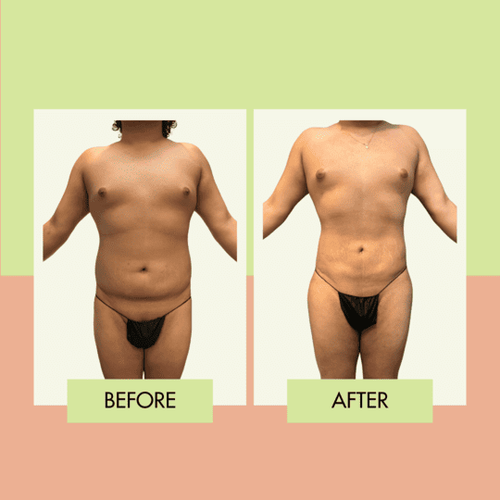
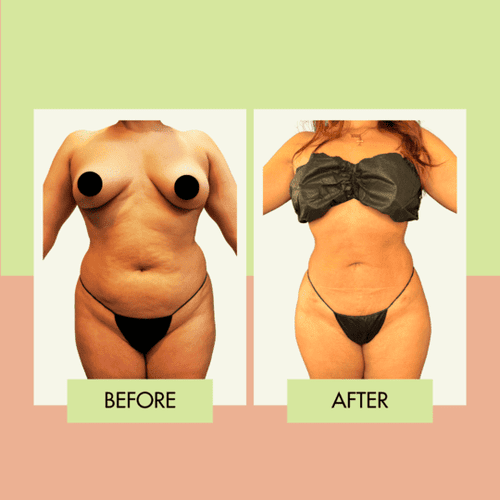
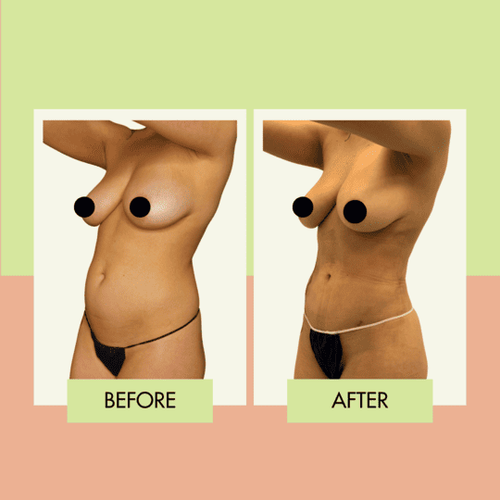
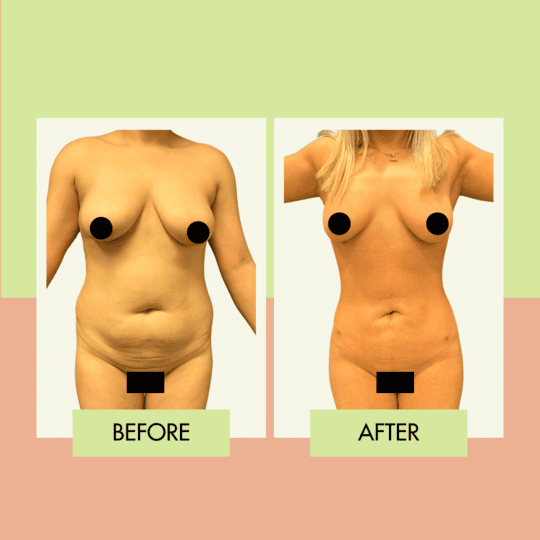
Individual results vary. Photos are shared with patient consent. A consultation is required to determine what may be realistic for your anatomy.
Lipo 360 removes fat. It does not fix every cause of abdominal fullness.
If the main issue is localized fat and your skin has enough elasticity to retract, circumferential liposuction may be an appropriate contouring option. But liposuction does not tighten separated abdominal muscles and it cannot remove substantial loose, hanging skin.[1][5]
That is why a patient with post-pregnancy muscle separation or significant skin laxity may get a better result from a tummy tuck or a combination procedure. The procedure is also not a treatment for obesity and should not be presented as a substitute for diet, exercise, or medical weight management.
The right plan is the one that matches the anatomy in front of the surgeon. If this is not the procedure that will give you the result you are asking for, we would rather tell you that before surgery.
Recovery is more involved than single-area liposuction.
Because treatment may involve multiple torso zones, swelling, soreness, compression, and positioning can affect the entire midsection. Many patients can return to desk-based work within about a week, but recovery varies, swelling can persist, and the contour continues refining for several months.[4]
Swelling, soreness, compression
Expect bruising, circumferential swelling, tenderness, and limited mobility. Light walking begins early, while your compression garment supports the treated areas.
Desk work often resumes
Many patients return to sedentary work in roughly five to seven days. Swelling remains significant even when daily activity is becoming easier.
Definition becomes clearer
Waist definition becomes easier to see as swelling decreases. Exercise and compression changes should follow your surgeon’s clearance.
The result continues to refine
Deep swelling resolves gradually, tissue softens, and skin retraction continues. The final result is not judged during the early recovery phase.
Want the week-by-week details? Read our Lipo 360 recovery guide, including compression, swelling, activity, and the timeline for final results.
Plan Lipo 360 around the procedure, the recovery, and where you live.
Adonis Plastic Surgery is a QUAD A-accredited outpatient surgical facility at 2557 Pacific Coast Highway, Torrance, CA 90505. Lipo 360 consultations, surgical planning, surgery-day care, and postoperative follow-up are coordinated through the Torrance practice.
We serve patients throughout Torrance, Redondo Beach, Lomita, Palos Verdes, Rolling Hills Estates, Harbor City, San Pedro, Gardena, Carson, Manhattan Beach, and the greater South Bay. Because Lipo 360 treats multiple torso zones, transportation after surgery, compression, mobility, and the ability to return for scheduled follow-up should be part of the plan before surgery.
Lipo 360 cost in Torrance and Los Angeles.
The price depends on the number of treatment zones, the amount of contouring required, your surgical plan, and whether an additional technology such as VASER is included. Your final price is confirmed after the surgeon evaluates your anatomy.
Lipo 360 at Adonis
$6,500 – $9,000Lipo 360 starts at $6,500, with many procedures falling within this range. Anesthesia is not included in these figures and is outlined separately in your personalized, itemized surgical quote.
Financing available
Qualified patients may use Cherry, CareCredit, Affirm, Klarna, or AfterPay to divide eligible surgical costs into payments. Terms and approval are determined by the financing provider.
VIEW PAYMENT PLANSIf you are comparing surgical quotes, compare the actual scope of treatment and what each quote includes—not only the headline price. Surgeon fees, anesthesia, facility fees, technology add-ons, garments, and follow-up care can be structured differently between practices.
Common questions about 360 liposuction.
What areas are included in Lipo 360?
It generally refers to circumferential liposuction of the midsection, commonly including some combination of the upper and lower abdomen, waist, flanks, and lower back. The exact zones are customized to your anatomy rather than treated as a fixed package.
Which surgeons perform Lipo 360 at Adonis Plastic Surgery?
Lipo 360 at Adonis is performed by Dr. Joshua Y. Jacobson and Dr. Shana S. Kalaria. Both are certified by the American Board of Plastic Surgery and are members of the American Society of Plastic Surgeons. Dr. Jacobson medically reviewed this page.
Where is Lipo 360 surgery performed at Adonis?
Adonis Plastic Surgery is a QUAD A-accredited outpatient surgical facility at 2557 Pacific Coast Highway in Torrance, California 90505. Surgical planning and postoperative follow-up are coordinated through the Torrance practice.
What is the difference between Lipo 360 and regular liposuction?
Regular liposuction can target one isolated area or several separate areas. The 360-degree approach treats the torso as a continuous contour, treating the front, sides, and back together so the transitions around the waist are planned from every angle.
Is Lipo 360 the same as VASER liposuction?
No. The name describes the circumferential treatment pattern. VASER is an ultrasound-assisted liposuction technology that may be incorporated into a surgical plan when appropriate. It is not automatically included in every Lipo 360 procedure.
Is Lipo 360 a weight-loss procedure?
No. The procedure is intended for body contouring and localized fat reduction. It is not a treatment for obesity or a substitute for weight loss. Patients who are near a stable weight with stubborn midsection fat are generally better candidates.
How do I know whether I need Lipo 360 or a tummy tuck?
If the primary issue is fat and your skin has good elasticity, circumferential liposuction may be enough. If you have significant loose skin or separated abdominal muscles, liposuction alone cannot correct those concerns and a tummy tuck may be more appropriate. Your surgeon determines this after examining you.
How long does Lipo 360 take?
The procedure commonly takes about two to four hours, depending on the number of zones treated, the amount of contouring required, and whether another procedure is performed at the same time.
How long is Lipo 360 recovery?
Most patients can return to desk-based work in approximately five to seven days, although swelling and soreness remain. Exercise usually returns gradually after clinical clearance, and the contour continues refining for several months. Recovery varies by patient and surgical plan.
When will I see my final Lipo 360 results?
You may notice an early change once initial swelling begins to fall, but the final result takes time. Deeper swelling, firmness, and skin retraction continue improving over several months, with the mature contour commonly assessed around the five- to six-month point.
Are Lipo 360 results permanent?
The improvement can be long-lasting when weight remains reasonably stable. Significant weight gain can alter the contour over time because remaining fat cells can enlarge.[6]
Will I need a compression garment after Lipo 360?
Yes. Circumferential compression is an important part of recovery. The exact garment schedule and when you transition or stop wearing it are determined by your surgeon and clinical team based on your healing.
Can Lipo 360 be combined with a BBL?
Sometimes. Circumferential liposuction is commonly used to contour the waist and torso in patients who are also undergoing fat transfer to the buttocks. Whether a BBL can be performed safely as part of your plan depends on your anatomy, available donor fat, health, and the surgeon’s assessment.
Can Lipo 360 get rid of cellulite or loose skin?
Liposuction is not a reliable treatment for cellulite and it does not remove substantial loose skin. Skin quality is one of the most important factors in determining whether liposuction alone will create the contour you want.
What are the risks of Lipo 360?
Circumferential liposuction carries the risks associated with surgical liposuction, including bleeding, infection, fluid collections, contour irregularity, asymmetry, changes in sensation, scarring, blood clots, anesthesia complications, and the possibility of revision. Your surgeon reviews the risks relevant to your health and surgical plan before you consent to surgery.[5][8]
How much does Lipo 360 cost in Torrance or Los Angeles?
At Adonis, Lipo 360 starts at $6,500, with many procedures ranging from $6,500 to $9,000 depending on the treatment areas and surgical plan. Anesthesia is not included in that range and is outlined separately in the personalized quote you receive after consultation.
Do you see Lipo 360 patients from outside Torrance?
Yes. Adonis Plastic Surgery is in Torrance and serves patients throughout the South Bay and Greater Los Angeles, including Redondo Beach, Palos Verdes, Manhattan Beach, El Segundo, Long Beach, Gardena, Carson, Lomita, and San Pedro.
Clinical information reviewed against independent medical sources.
This page was medically reviewed by Joshua Y. Jacobson, MD, an American Board of Plastic Surgery-certified plastic surgeon, on September 10, 2026. The sources below support the general educational information about liposuction candidacy, technique, recovery, results, risks, skin elasticity, and ultrasound-assisted technology. They do not replace individualized medical advice.
American Society of Plastic Surgeons
American Society of Plastic Surgeons
American Society of Plastic Surgeons
American Society of Plastic Surgeons
American Society of Plastic Surgeons
American Society of Plastic Surgeons
American Society of Plastic Surgeons
PubMed / U.S. National Library of Medicine
PubMed / U.S. National Library of Medicine
Joshua Y. Jacobson, MD · ASPS profile
Find out what your midsection actually needs.
Meet with one of our board-certified plastic surgeons to discuss your anatomy, goals, candidacy, expected recovery, and whether Lipo 360, a tummy tuck, traditional liposuction, or another plan best matches the tissue you actually have. You will receive a clear surgical recommendation and detailed quote before deciding whether to move forward.