

How Effective is Calf Liposuction for Leg Contouring?
Updated April 2026
The Honest Answer to Whether Calf Liposuction Actually Works
Calf liposuction is one of the more nuanced procedures in body contouring, and patients who research it deserve a more honest answer than most plastic surgery content provides. The short version is that calf liposuction is effective, produces permanent results, and consistently satisfies patients who are good candidates. The longer version is that candidacy for calf liposuction is more restricted than for most other areas, the recovery is more demanding due to the anatomy of the lower leg, and the technique requires a level of precision that makes the choice of clinical team more consequential than for many other procedures.
This article covers all of it: the anatomy of calf fullness and why most people are not candidates, what makes someone a genuine candidate, what the procedure involves, how effective it is and under what conditions, what recovery actually looks like, and how calf liposuction fits into a broader leg contouring plan.
Why Most Calf Fullness Is Not a Fat Problem
This is the most important point in any honest discussion of calf liposuction, and the one most often glossed over. The calves are predominantly a muscle-driven structure. The gastrocnemius and soleus muscles, which make up the bulk of the calf, are among the most consistently developed muscles in the body because they are engaged with every step taken throughout the day. For the majority of patients who are unhappy with the size or shape of their calves, the issue is muscular volume rather than fat accumulation.
Liposuction removes fat. It cannot reduce muscle volume. A patient with large, well-developed calf muscles who undergoes calf liposuction will see little to no change in calf circumference, because the fat layer in that area is thin relative to the muscular bulk beneath it. This is why the pre-operative evaluation for calf liposuction specifically includes an assessment of the ratio of fat to muscle in the treatment area, and why a significant proportion of patients who inquire about the procedure are advised that it is not the appropriate solution for their specific anatomy.
Patients who are genuine candidates for calf liposuction are those who have a meaningful subcutaneous fat layer in the calf area that is disproportionate to their overall body composition, where the fat rather than the muscle is the primary driver of the fullness they want to address. This patient profile exists, but it is less common than for thigh, abdominal, or flank liposuction.
Who Is a Good Candidate
The ideal candidate for calf liposuction is an adult who is at or near a stable, healthy weight with disproportionate fat accumulation in the calf area that has not responded to diet and exercise, and where the treating clinical team has confirmed through physical evaluation that the fullness is primarily fat rather than muscle.
Additional candidacy considerations specific to the calf area include:
Skin elasticity. The skin of the lower leg is thinner than in most other liposuction treatment areas and has limited elasticity in many patients. Good skin retraction following fat removal is essential to a smooth result, and patients with significantly reduced skin elasticity in the calf area may not achieve the clean contour improvement that the procedure can produce in patients with better skin quality.
Circulatory health. The lower legs are the area of the body most susceptible to venous and lymphatic insufficiency. Patients with varicose veins, a history of deep vein thrombosis, significant venous insufficiency, or lymphedema are not appropriate candidates for calf liposuction. A thorough pre-operative health review identifies these factors before any surgical plan is made.
Realistic expectations about the degree of change. The calf area has a thinner fat layer than most other liposuction zones, which means the volume removed is less than for abdominal or thigh procedures and the degree of circumferential reduction is more modest. Patients expecting dramatic size reduction are generally not the right candidates. Patients seeking a meaningful improvement in the proportion and definition of the lower leg, and who understand that the change will be refined rather than dramatic, are the ones most consistently satisfied with the outcome.
How Effective Is It: What the Evidence Shows
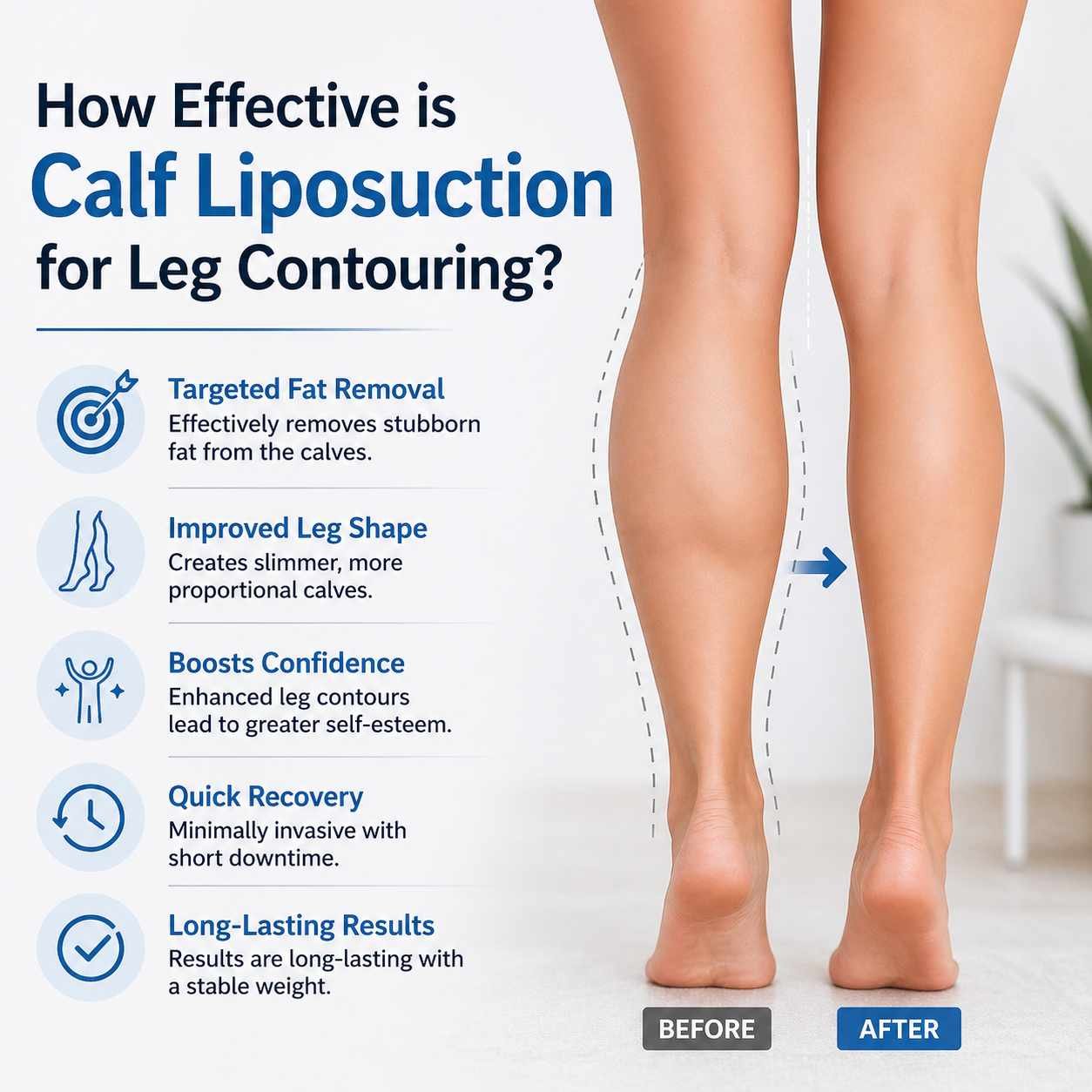
For appropriately selected candidates, calf liposuction is consistently effective at reducing lower leg circumference, improving the contour transition between the calf and ankle, and producing a slimmer, more defined leg silhouette. Results are permanent in that the fat cells removed do not regenerate. Patients who maintain a stable weight after the procedure retain their improved lower leg contour long term.
The technical demands of calf liposuction are higher than for most other areas. The proximity of important neurovascular structures in the lower leg, including the sural nerve and the small saphenous vein, requires careful technique to avoid injury. Uneven fat removal in the calf produces visible surface irregularities that are particularly noticeable in this area because the calf is viewed from multiple angles in everyday clothing, swimwear, and footwear contexts. Research published in the National Institutes of Health database on lower extremity liposuction outcomes documents that patient satisfaction is strongly correlated with appropriate candidate selection and precision of technique, reinforcing that this is a procedure where the quality of the clinical evaluation and execution matters significantly.
The effectiveness of calf liposuction is also meaningfully influenced by whether it is combined with ankle liposuction. The calf and ankle form a continuous visual unit, and improving calf contour without addressing ankle fullness, when ankle fullness is present, can create a result that looks segmented rather than proportionate. Many patients who seek calf liposuction benefit from concurrent ankle treatment to achieve a harmonious lower leg result.
The Procedure
Calf liposuction is performed under local anesthesia with sedation or general anesthesia depending on the extent of treatment and patient preference. The tumescent solution is injected into the treatment area, the cannula is inserted through small incisions typically placed at the ankle or behind the knee where they will be naturally concealed, and fat is removed with careful attention to the depth and distribution of removal to avoid contour irregularities and proximity to neurovascular structures.
The volume of fat removed in calf liposuction is typically smaller than in abdominal or thigh procedures, and the procedure time is correspondingly shorter, usually one to two hours for bilateral calf treatment. Incisions are small and placed to minimize visible scarring once healed.
For patients also addressing thigh fullness, combining calf and thigh liposuction in a single session treats the entire leg as a proportional unit and is generally more efficient than staging the procedures separately, provided the total treatment volume is within safe limits.
Recovery: Why the Lower Leg Is the Most Demanding Area
Recovery from calf liposuction is more demanding than most liposuction procedures, and patients need to understand this before committing to the procedure. The reason is straightforward: gravity continuously pulls post-operative fluid downward into the lower leg and foot. There is no position in which the calf is naturally elevated above the heart during normal sitting or standing activity, which means that managing swelling requires deliberate and consistent effort throughout the recovery period.
Compression: Graduated compression stockings or garments are worn for six weeks minimum, longer than most other liposuction areas. The compression is particularly critical in the calf because of the circulatory demands of the lower extremity and the need to counteract gravitational fluid accumulation. Consistent compression wear directly affects both the final result and the DVT risk during recovery.
Elevation: Keeping the legs elevated above heart level whenever resting is the single most effective thing patients can do to manage swelling after calf liposuction. This means lying down with the legs propped on pillows rather than sitting with the legs hanging. The more consistently patients maintain elevation during the first two to three weeks, the faster swelling resolves and the sooner the result becomes visible.
Walking and circulation: Short, gentle walks from day one are encouraged for circulation and DVT prevention, as recommended by the Centers for Disease Control for post-surgical patients with reduced mobility. Extended periods of standing or sitting with the legs dependent should be avoided during the first two weeks.
Return to activity: Light activity can typically resume at two to three weeks. Running, high-impact exercise, and leg-intensive training are cleared at the six-week appointment. Most patients return to desk work within one week.
Results timeline: Initial slimming of the calf is often visible at four to six weeks as peak swelling resolves. Because of the gravitational challenges in the lower leg, full results including complete swelling resolution and final skin retraction take longer than most other areas, typically six months to a year for the calf and ankle zone. Patients need to be specifically counseled on this extended timeline before proceeding.
Calf Liposuction as Part of a Complete Leg Contouring Plan
Most patients seeking calf liposuction are interested in the overall appearance of their legs rather than the calf in isolation. Evaluating the complete leg, from the thigh through the knee, calf, and ankle, allows for a contouring plan that produces a proportionate, harmonious result rather than an improvement in one area that highlights imbalances elsewhere.
Common combinations include calf and ankle liposuction together for patients with lower leg fullness throughout, and calf liposuction combined with thigh treatment for patients seeking overall leg slimming. Some patients also benefit from calf treatment as part of a broader body contouring plan that includes abdominal or flank work, particularly when overall body proportion is the driving goal.
At Adonis Plastic Surgery, lower body contouring consultations evaluate the entire leg as a unit. The recommendation reflects what the specific patient's anatomy actually requires rather than a predetermined procedure list.
For patients working through the financial planning side of a procedure, our payment plans and financing options are available to review as part of the overall planning process.
Ready to Find Out If You Are a Candidate?
The most important step for anyone considering calf liposuction is an honest in-person evaluation that assesses whether the fullness you want to address is fat, muscle, or a combination of both. That assessment determines whether calf liposuction is the right tool for your goals or whether a different approach would serve you better.
Adonis Plastic Surgery serves patients throughout the South Bay, including Torrance, Redondo Beach, Palos Verdes, El Segundo, Manhattan Beach, Long Beach, Carson, Gardena, and surrounding communities.
